Dell Technologies is somewhat of a contrarian when it comes to business trends. While other major technology providers have been busy downsizing and pulling their organisation apart, for example Ericsson and HP, Dell Technologies went in the opposite direction, pulling together a mega-merger and bringing together satellite companies in adjoining spaces.
Led by its iconic founder, chairman and CEO Michael Dell, the company has set its sights on becoming the No.1 IT super-power with strengths in computing, storage and networking. It retains its crown as leading supplier of laptops and desktops while pushing ahead in new areas through marquee brands, such as RSA for cybersecurity and VMware for network virtualisation.
Dell’s $67 billion acquisition of EMC, first announced in October 2015 and completed 11 months later, ranks as the largest tech merger of all time. For comparison, HP’s acquisition of Compaq was valued at $33 billion, Microsoft’s acquisition of LinkedIn is valued at $26.2 billion, Facebook’s acquisition of WhatsApp was valued at $19.1 billion, and Google’s acquisition of Motorola at $13.2 billion.

Dell Technologies, is a public company with a class V tracking stock that trades on NYSE under the symbol DVMT. It is the successor to Dell and EMC, which merged in September 2016. Dell Technologies reported 2016 revenue of $61.642 billion with a net loss of $3.737 billion. The company has some 138,000 employees and is based outside of Austin, Texas.
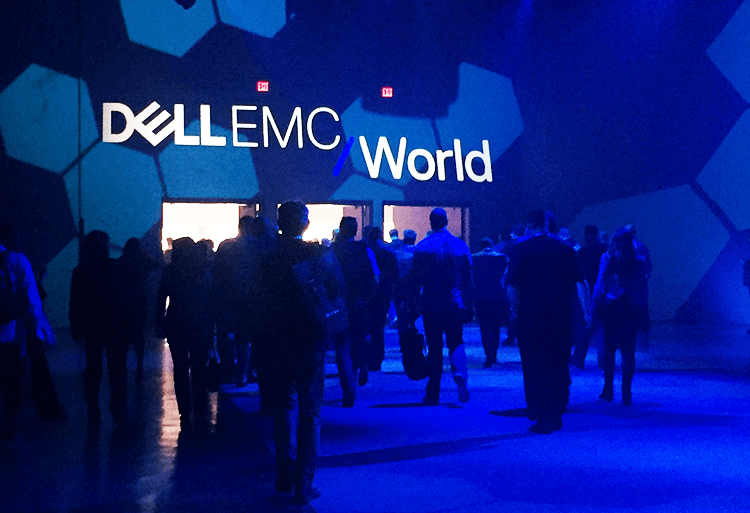
This week, the company attracted an estimated 13,500 of its customers and partners to its first integrated Dell EMC World conference at the Venetian in Las Vegas. The event served as the debutante ball for the newly integrated Dell Technologies empire and the launch pad for several critical products: its 14th generation of Dell PowerEdge servers, due out this summer, new all-Flash storage solutions, more Hyperconverged platforms, its first 25 Gbit/s networking solutions and a new consumption model for its IT products.
The theme at Dell EMC World was transformation, not just for the newly-merged company but for its customers as they become cloud-enabled businesses. The event was the opportunity to showcase how marquee customers such as Boeing, Citibank, Nike and Jaguar Land Rover are not just updating their IT hardware but fully-transforming themselves into ‘digital’ companies. The goal was to get customers talking about how IT does not just run the business, it is the business. For its own business, the Las Vegas event was the opportunity to show how the pieces of its empire are coming together to ensure bigger sales and better feedback.
David Goulden, president of Dell’s Infrastructure Solutions Group, said the private business structure enables the company to make strategic investments and operational changes that would have been difficult as a public entity, where every move is judged by the impact on its quarterly financial statements. Goulden cited two areas: moving the IT industry toward a pay-on-consumption model (more on this below), and longer-term R&D investments that put a strain on current financials but set the stage for future growth.
Dell Technologies is essentially a holding company with seven brands under a single umbrella, as follows:
- Dell – supplies PCs, laptops, printers and monitors, and currently ranks as the third largest PC company in the world with a market share of about 16%.
- Dell EMC – IT solutions, including servers, all-flash storage solutions, hyper-converged appliances, cloud and data centre products.
- Pivotal – the San Francisco-based cloud foundry that helps mission-critical applications run better in the cloud.
- RSA – the iconic cybersecurity company and operator of the annual RSA Conference on network security.
- Virtustream – cloud computing management software.
- VMware – the network virtualisation company based in San Francisco.
Competition in the public cloud
It is well known that in the networking business, the pendulum swings back and forth from public to private. Sometimes it is better to use resources on a shared infrastructure and at other times economics will dictate that it is better to build your own network. In various presentations throughout the week, Dell executives made it clear that the big public cloud companies are not the perfect solution for every app and every customer. Both Michael Dell and Tom Sweet, the company’s CFO, said the public cloud can be 2.5 times more expensive for some applications compared to an on-premise hardware solution. This 2.5x cost saving factor could be a huge competitive advantage for Dell EMC, although it appears to be a ‘soft’ number based on anecdotal evidence rather than a formal study that could be analysed in depth.
Nevertheless, one can see where this discussion is headed. One after another, Fortune 500 companies have been consolidating their data centres and moving many of their most innovative workloads into AWS, Microsoft Azure, IBM Softlayer or Google Cloud Engine. Some big players, such as Netflix, have even boldly stated that they are all in for public cloud services. The IT budgets that are now paying for cloud services were previously being spent equipment from the likes of Dell or its competitors. But in his keynote address, Michael Dell said that he is not worried, the current public cloud enthusiasm just reflects the exuberance of an early market. The Dell view is that: (1) it will be a multi-cloud world rather than an industry dominated by just one or two players; (2) hybrid clouds are logical outcome; (3) Dell EMC is already the leading supplier of hyperconverged platform and any organisation moving to a hybrid data centre will needs solutions that can tie together the multi-cloud strategy.
(Part 2 will cover the key announcements from Dell EMC World.)