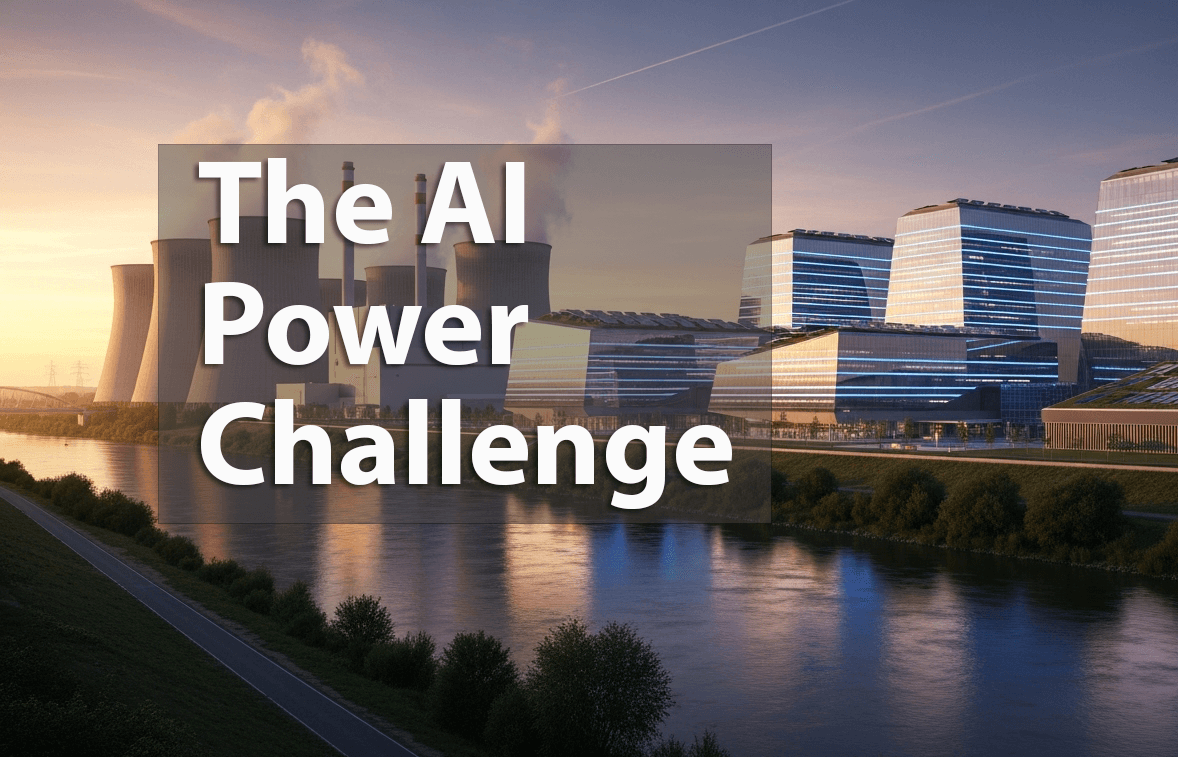
The explosive growth of artificial intelligence (AI) has transformed data centers from quiet back-end infrastructure into voracious consumers of electricity, reshaping global energy landscapes. Hyperscale data centers—massive facilities operated by Amazon, Google, Microsoft, and Meta—now demand power at scales that rival entire cities. A single AI campus can require 5–10 gigawatts (GW) of capacity, enough to power millions of homes.
According to the Dell’Oro Group, global data center capex is on track to exceed $1 trillion by 2029, with hyperscalers accounting for nearly half of spending by 2025. The International Energy Agency (IEA) projects that worldwide electricity use by data centers will more than double to 945 terawatt-hours (TWh) by 2030—equivalent to Japan’s total consumption today. In the U.S., the Department of Energy (DOE) estimates data center energy demand will rise from 176 TWh in 2023 to 325–580 TWh by 2028, roughly doubling or tripling growth projections for other sectors.
At the heart of this challenge lies the intersection of grid policy, renewable power purchase agreements (PPAs), and data-center site selection. Utilities, facing 5–10 GW of hyperscale demand in key regions, are scrambling to respond with new generation models—small modular reactors (SMRs), hydrogen systems, and on-site microgrids—while navigating regulatory friction and grid congestion. Renewable PPAs offer a pathway to decarbonization but often fail to deliver true 24/7 clean matching. The result is a global race to re-engineer how electricity and compute are planned together.
Utilities Under Siege: Responding to Hyperscale Demand
Utilities sit at the epicenter of this transformation, confronting load growth unseen in modern history. In Northern Virginia—the world’s largest data center hub—hyperscalers have queued up over 40 GW of contracted capacity, nearly double from a year ago. California’s PG&E anticipates 10 GW of new data-center demand within a decade, while the U.S. Energy Information Administration (EIA) predicts national power use will reach 4,193 billion kWh in 2025, with data centers as the fastest-growing segment.
Traditional grid expansions can’t keep up. Permitting for new 230 kV transmission lines can take up to a decade, while interconnection queues have ballooned to over 2 TW nationwide. Utilities and hyperscalers are therefore shifting to more flexible, distributed generation. Goldman Sachs forecasts total global data-center capacity reaching 122 GW by 2030, driven by modular and hybrid power solutions.
Small modular reactors (SMRs) are emerging as a serious candidate for round-the-clock, carbon-free baseload power. With modular units up to 300 MW each, SMRs offer scalability, short build times, and resilience. AWS has partnered with X-energy to pursue 5 GW of SMR capacity by 2039, and Google has inked a 500 MW deal with Kairos Power across six sites. A Schneider Electric analysis concluded that SMRs align more closely with data-center load profiles than intermittent renewables, enabling near-constant uptime with minimal curtailment.
Hydrogen generation is also gaining traction—both as primary fuel and backup. Microsoft began testing hydrogen fuel cells in 2020 and plans 3 MW systems to replace diesel generators. ECL, which opened a 1 GW off-grid “AI Factory” near Houston in 2025, runs entirely on modular hydrogen fuel cells, achieving a PUE below 1.1 while recycling fuel-cell water for cooling. Hydrogen’s dual role—storage and generation—allows it to absorb excess renewables and dispatch power instantly during peaks.
Meanwhile, “power islands” are emerging as a pragmatic compromise—self-contained microgrids that combine gas turbines, solar, and batteries to achieve 99.999% uptime. Hyperscalers like Meta and Google already co-locate such systems to bypass interconnection delays. The DOE’s $50 million High-Renewable Microgrid Program supports these designs, which could shorten deployment cycles by years and turn data centers into grid-supporting assets.
Renewable PPAs: A Green Lifeline with Limits
Renewable PPAs remain the main sustainability mechanism for hyperscalers, who collectively represent over half of all corporate renewable procurement worldwide. Amazon alone backed 500+ projects in 2024, and Google’s 1.6 GW PPA for AI cloud regions marked the largest corporate clean-energy contract of its kind. These 10–15 year agreements guarantee long-term prices and accelerate renewable financing—but they don’t always deliver power where or when it’s needed.
Conventional PPAs are “virtual” offsets: they fund remote solar or wind farms whose output is matched to consumption through Renewable Energy Certificates (RECs). A Virginia data center powered by coal may still claim to be “green” by purchasing solar credits from Texas. Critics argue that such PPAs risk “greenwashing” and fail to achieve temporal matching—clean energy generated at the same time AI workloads run.
To address this, 24/7 clean PPAs are emerging. Microsoft and Google pioneered these agreements, integrating storage, smart trading, and hybrid renewables to match hourly usage. McKinsey estimates that 24/7 PPAs could enable 50–60 GW of new infrastructure by 2030, but only if utilities adopt real-time energy markets. The shift is forcing power providers to rethink tariffs, capacity credits, and balancing mechanisms to align intermittent generation with always-on compute demand.
Grid Policy: The Gatekeeper of Site Selection
Where power policy permits, data centers follow. Grid interconnection delays—some stretching beyond 10 years—now dictate global site strategy. PJM Interconnection, which manages the Mid-Atlantic grid, has 300 GW of queued projects; ERCOT in Texas faces shorter waits but operates under extreme volatility. In Europe, power and water limits have halted new builds in Dublin, Amsterdam, and Zurich, redirecting hyperscaler expansion toward Nordic hydro corridors and southern Europe’s solar basins.
Regulators are beginning to adapt. In the U.S., the DOE’s Speed-to-Power Initiative is streamlining permits for data-center loads above 200 MW and incentivizing on-site renewables. The American Council for an Energy-Efficient Economy (ACEEE) recommends tax incentives for co-location with renewable generation, pre-certified “grid-ready” parcels, and flexible tariffs for curtailment or grid services. In the EU, policymakers are targeting 8 GW of solar capacity tied directly to data centers by 2032.
Site-selection priorities have evolved. Operators now rank “grid adjacency” and “substation headroom” above fiber routes or land cost. Northern Virginia remains the world’s most interconnected cluster at 15 GW of operational and planned load, but secondary hubs like Dallas, Phoenix, and Atlanta are surging as power constraints shift investment inland.
Case Studies: Innovation in Action
Dominion Energy & Virginia Hyperscalers: Working on SMR pilots and direct nuclear PPAs to relieve the 40 GW backlog while improving carbon intensity.
ECL Houston AI Factory: A 600-acre off-grid hydrogen campus delivering 1 GW of continuous compute power with on-site water recycling and hybrid storage.
Google–Kairos Partnership: Deploying SMRs directly at data sites for 24/7 power matching, combining nuclear, solar, and battery storage.
IREN (Iris Energy): Using hydro and solar PPAs in British Columbia and Texas to power GPU clusters while maintaining 100% renewable credentials.
The Economics of Power Density
The economics of AI data centers are shifting from square footage to megawatts per rack. Traditional enterprise racks consume 10–15 kW, while AI racks can exceed 100 kW, with extreme cases approaching 150 kW for dense GPU pods. Cooling, distribution, and power conditioning now dominate infrastructure costs. Operators that secure affordable power early are gaining lasting cost advantages: power now accounts for 40–60% of OPEX.
Investment models are evolving, too. Venture and REIT investors increasingly measure success in $/MW deployed rather than $/server—mirroring the metrics of energy infrastructure, not IT. As AI workloads grow, financial markets are treating compute sites as “digital power plants”—assets whose value is tied directly to sustained energy throughput and uptime guarantees.
Conclusion: Power Defines the Pace of AI
The AI era is converging with the biggest power reconfiguration in a century. Dell’Oro, IEA, and DOE projections all point to an unprecedented collision between digital expansion and energy scarcity. The next generation of compute infrastructure will depend not just on chip supply chains but on gigawatts, gigajoules, and gigabytes—all synchronized.
Hydrogen, SMRs, and 24/7 clean PPAs mark the blueprint for resilience, but policy innovation must keep pace. Utilities will need to evolve from passive suppliers into strategic partners for compute, co-developing energy and digital ecosystems. The future of AI won’t be limited by algorithms—it will be defined by amperage.
Nuclear and Fusion Projects Targeting AI Data Center Power
| Project / Company | Project Description | Location & Timeline | Size / Partners / Funding |
|---|---|---|---|
| X-energy — Xe-100 Program (AWS Partnership) | High-temperature gas-cooled SMR designed to provide firm, carbon-free baseload for AI and data-center demand. Strategic collaboration with Amazon Web Services, KHNP, and Doosan Enerbility. | Multiple U.S. sites; first deployment in the Pacific Northwest by early 2030s; program scaling through 2039. | Modular 80 MW units; fleet target above 5 GW; combined private-public funding approaching $50 B. |
| Kairos Power — Hermes-2 (Google / TVA) | Fluoride-salt-cooled Gen IV reactor supplying 24/7 clean electricity for Google’s data-center operations under the first U.S. nuclear PPA for AI workloads. | Tennessee Valley region; Hermes-2 expected online around 2030; expansion to 500 MW program by 2035. | Initial 50 MW unit; partners: Google and TVA; part of a larger low-carbon regional fleet strategy. |
| Constellation — Microsoft PPA at Three Mile Island | Restart of the Three Mile Island Unit 1 reactor through a 20-year clean-power PPA with Microsoft, supporting hyperscale data-center expansion in the U.S. Mid-Atlantic. | Pennsylvania, USA; announced 2024; restart scheduled within five years. | 835 MW capacity; 20-year Microsoft offtake; operated by Constellation Energy. |
| TerraPower — Natrium x Sabey Data Centers | Collaboration exploring siting of Natrium advanced reactors adjacent to Sabey data-center campuses, enabling hybrid nuclear-storage power for AI compute. | U.S. multi-state siting study; first deployment after Wyoming FOAK project, late 2030s. | 345 MW Natrium reactors with molten-salt energy storage; partners: Sabey Data Centers and DOE. |
| Oklo — Micro-Reactor Designs with Vertiv | Compact fast reactors integrated with Vertiv cooling and energy systems to provide on-site, grid-independent power for hyperscale or edge data centers. | U.S. pilot architectures under design; commercialization aligned to mid-2030s licensing cycle. | Units in 10–50 MW range; partners: Vertiv, DOE ARPA-E; public company listed on NYSE: OKLO. |
| Helion — Fusion PPA with Microsoft | First commercial fusion electricity contract globally; Helion’s upcoming Orion plant will deliver zero-carbon power directly to Microsoft data-center operations. | Everett, Washington; commercial delivery targeted for 2028, subject to successful plasma milestones. | Up to 50 MW contracted output; partners: Microsoft and Constellation; funding above $600 M. |
| GE Vernova / Hitachi — BWRX-300 Fleet | Modular boiling-water SMR platform advancing in Canada, Finland, and the U.S.; targeted for data-center-adjacent firm-power deployment. | Ontario and Tennessee under construction planning; Nordic licensing with Fortum; first units by 2032. | 300 MW per reactor; partners: OPG, TVA, Fortum; strong utility co-funding and DOE cost-share. |
| Holtec / EDF / Tritax — UK SMR Data-Center Project | Europe’s first SMR-powered data-center campus planned in Nottinghamshire as part of the UK–US nuclear energy initiative. | Nottinghamshire, UK; early design phase, 2025 announcement; deployment by early 2030s. | SMR capacity TBD; partners: EDF and Tritax; part of UK’s “Great British Nuclear” roadmap. |
| Fermi America — Amarillo AI Campus | Nuclear-integrated data-center REIT campus combining SMRs, gas turbines, and renewables to deliver multi-GW firm power for AI workloads. | Amarillo, Texas; groundbreaking late 2025; first 2 GW energized by 2027. | 11 GW ultimate campus capacity; $682 M IPO proceeds; partners include Texas Tech University and NuScale. |
| newcleo — Lead-Cooled Fast Reactor Program | Advanced modular reactors using lead cooling and recycled MOX fuel; potential clean-firm option for future European data-center power. | France and Slovakia; 30 MW pilot reactor planned by 2031. | Over €400 M raised; partners: JAVYS and VUJE; roadmap toward 200 MW commercial modules. |
Note: Listed projects reflect public disclosures as of October 2025. Capacities and timelines are indicative and subject to regulatory and financing progress.
🌐 We’re tracking the latest developments in AI infrastructure, power systems, and data-center energy policy.
Follow our ongoing coverage at: https://convergedigest.com/category/data-centers/
 | Converge Digest and NextGenInfra.io are bringing together the leaders shaping AI-driven data center networks—from optics and fabrics to silicon and orchestration.
Explore how the industry is re-architecting the network for the AI era through exclusive video interviews,
expert reports, and collaboration opportunities. |