• Home
  • Events Calendar
  • Blueprint Guidelines
  • Privacy Policy
  • Subscribe to Daily Newsletter
  • NextGenInfra.io
No Result
View All Result
Converge Digest
Friday, April 17, 2026
  • Home
  • Events Calendar
  • Blueprint Guidelines
  • Privacy Policy
  • Subscribe to Daily Newsletter
  • NextGenInfra.io
No Result
View All Result
Converge Digest
No Result
View All Result

Home » South Atlantic Cable System ready for service with Angola-Brazil

South Atlantic Cable System ready for service with Angola-Brazil

September 30, 2018
in Subsea
A A

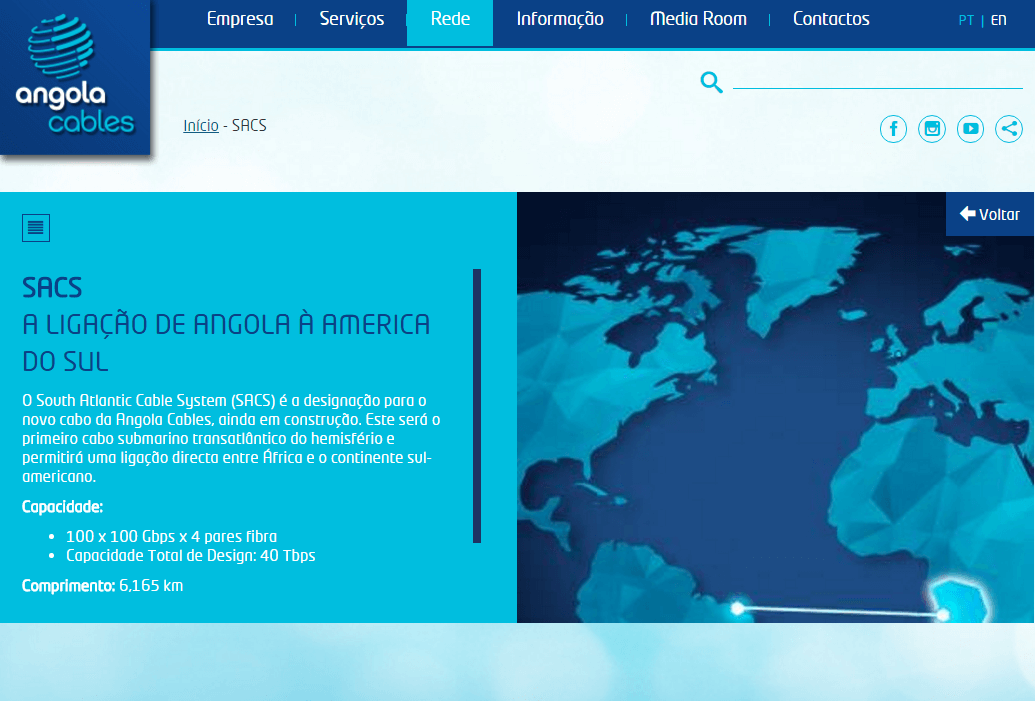
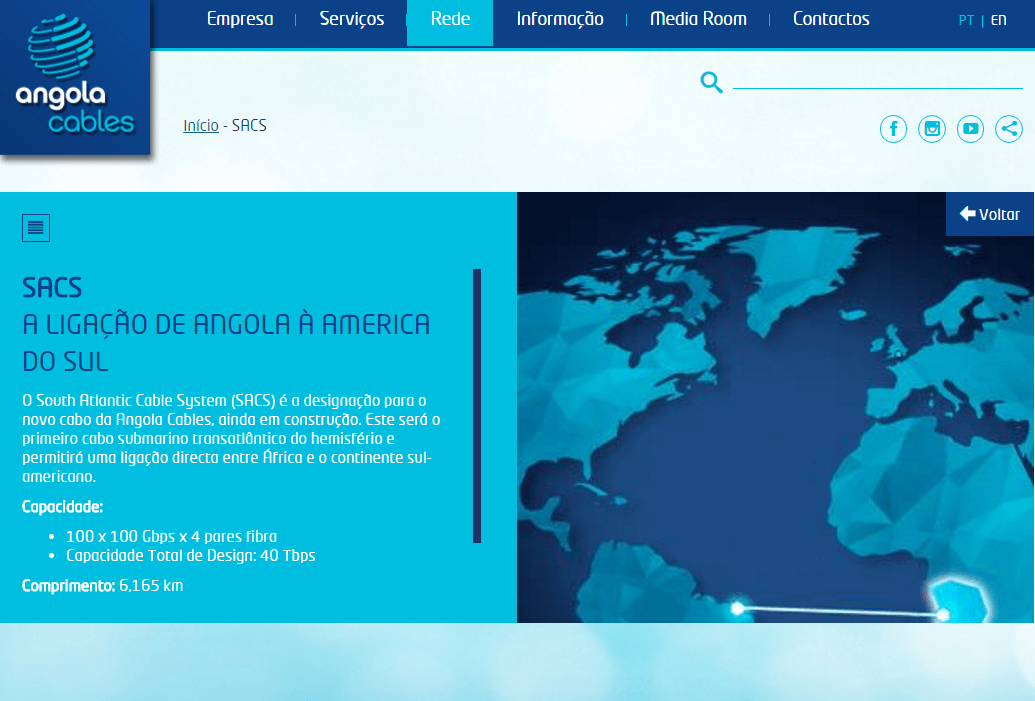
The South Atlantic Cable System (SACS), which is a 40 Tbps, 6,165 km cable linking Angola to Brazil, is now on-stream and open for commercial traffic.

SACS features four fibre pairs, with each fibre pair capable of transmitting 100 wavelengths at 100 Gbps. NEC served as lead contractor on the project.

The SACS cable system lands at Sangano cable landing station in Angola, near the capital city of Luanda, and will provide onward connectivity to the Angonap data center. In Brazil, SACS lands directly in a newly constructed data center, which was built together with SACS and for another cable system connecting Brazil to the U.S.A.

SACS is 100% owned by Angola Cables.

SACS was partially f

unded by the Japan Bank for International Cooperation (JBIC) through a loan agreement in buyer’s credit with Banco de Desenvolvimento de Angola (BDA), the state-owned development bank of Angola. The loan was co-financed with Sumitomo Mitsui Banking Corporation (SMBC) with Nippon Export and Investment Insurance (NEXI) providing insurance for the portion financed by SMBC.

“Our ambition is to transport South American and Asian data packets via our African hub using SACS, and together with Monet and the WACS, provide a more efficient direct connectivity option between North, Central and South America onto Africa, Europe and Asia. By developing and connecting ecosystems that allow for local IP traffic to be exchanged locally and regionally, the efficiency of networks that are serving the Southern Hemisphere can be vastly improved. As these developments progress they will have considerable impact for the future growth and configuration of the global internet,” said Mr. Antonio Nunes, Chief Executive Officer of Angola Cables.

Tags: SACS
ShareTweetShare
Previous Post

Facebook open sources LogDevice data store

Next Post

SSE teams with Three UK and O2 for fibre through London sewers

Staff

Staff

Related Posts

NEC Begins Work on South Atlantic Cable System
All

NEC Begins Work on South Atlantic Cable System

April 5, 2016
Next Post
SSE teams with Three UK and O2 for fibre through London sewers

SSE teams with Three UK and O2 for fibre through London sewers

Please login to join discussion

Categories

  • 5G / 6G / Wi-Fi
  • AI Infrastructure
  • All
  • Automotive Networking
  • Blueprints
  • Clouds and Carriers
  • Data Centers
  • Enterprise
  • Explainer
  • Feature
  • Financials
  • Last Mile / Middle Mile
  • Legal / Regulatory
  • Optical
  • Quantum
  • Research
  • Security
  • Semiconductors
  • Space
  • Start-ups
  • Subsea
  • Sustainability
  • Video
  • Webinars

Archives

Tags

5G All AT&T Australia AWS Blueprint columns BroadbandWireless Broadcom China Ciena Cisco Data Centers Dell'Oro Ericsson FCC Financial Financials Huawei Infinera Intel Japan Juniper Last Mile Last Mille LTE Mergers and Acquisitions Mobile NFV Nokia Optical Packet Systems PacketVoice People Regulatory Satellite SDN Service Providers Silicon Silicon Valley StandardsWatch Storage TTP UK Verizon Wi-Fi
Converge Digest

A private dossier for networking and telecoms

Follow Us

  • Home
  • Events Calendar
  • Blueprint Guidelines
  • Privacy Policy
  • Subscribe to Daily Newsletter
  • NextGenInfra.io

© 2025 Converge Digest - A private dossier for networking and telecoms.

No Result
View All Result
  • Home
  • Events Calendar
  • Blueprint Guidelines
  • Privacy Policy
  • Subscribe to Daily Newsletter
  • NextGenInfra.io

© 2025 Converge Digest - A private dossier for networking and telecoms.

This website uses cookies. By continuing to use this website you are giving consent to cookies being used. Visit our Privacy and Cookie Policy.
Go to mobile version