• Home
  • Events Calendar
  • Blueprint Guidelines
  • Privacy Policy
  • Subscribe to Daily Newsletter
  • NextGenInfra.io
No Result
View All Result
Converge Digest
Sunday, April 12, 2026
  • Home
  • Events Calendar
  • Blueprint Guidelines
  • Privacy Policy
  • Subscribe to Daily Newsletter
  • NextGenInfra.io
No Result
View All Result
Converge Digest
No Result
View All Result

Home » Toshiba develops bridge chip using PAM 4 to boost SSD speed and capacity

Toshiba develops bridge chip using PAM 4 to boost SSD speed and capacity

February 21, 2019
in All
A A

Toshiba Memory has developed a bridge chip for connecting flash memory chips into faster and higher capacity SSDs.

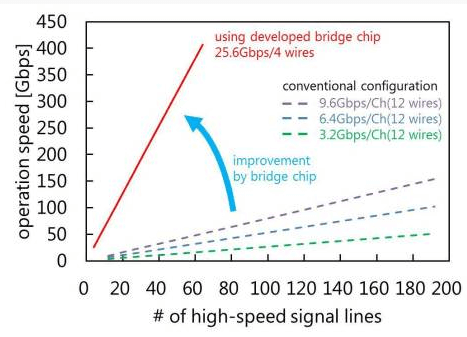
In SSDs, multiple flash memory chips are connected to a controller that manages their operation. As more flash memory chips are connected to a controller interface, operating speed degrades, so there are limits to the number of chips that can be connected. In order to increase capacity, it is necessary to increase the number of interfaces, but that results in an enormous number of high-speed signal lines connected to the controller, making it more difficult to implement the wiring on the SSD board.

Toshiba said it has overcome this problem with the development of a bridge chip that connects the controller and flash memory chips (Fig. 1), three novel techniques: a daisy chain connection including the controller and bridge chips in a ring shape; a serial communication using PAM 4; and a jitter improvement technique for eliminating a PLL circuit in the bridge chips. By using these techniques overhead of the bridge chips is reduced, and it is possible to operate a large number of flash memory chips at high speed with only a few high-speed signal lines.

The ring-shape configuration of the bridge chips and the controller reduces the number of transceivers required in the bridge chip from two pairs to one pair, it achieves chip area reduction of the bridge chip. In addition, adopting PAM 4 serial communication between the controller and the daisy-chained bridge chips lowers the operating speed in the bridge chips’ circuits and relaxes their required performance.

The prototype bridge chips were fabricated with 28nm CMOS process, and results were evaluated by connecting four bridge chips and a controller in ring-shape daisy chain.

Tags: Blueprint columnsToshiba
ShareTweetShare
Previous Post

Boingo appoints new CEO

Next Post

IP Infusion announces white box partnership with Infinera

Staff

Staff

Related Posts

BT, Equinix, Toshiba Introduce Quantum Key Distribution at London Data Centers
Quantum

BT, Equinix, Toshiba Introduce Quantum Key Distribution at London Data Centers

September 15, 2024
Blueprint: Brazil looks to municipal Wi-Fi 6E
Blueprints

Blueprint: Brazil looks to municipal Wi-Fi 6E

February 21, 2023
Blueprint: Building wholesale networks with OTN
All

Blueprint: Building wholesale networks with OTN

December 20, 2022
Oracle opens cloud region in Chicago
All

Oracle opens cloud region in Chicago

December 20, 2022
BT trials C-RAN in Leeds
All

BT trials C-RAN in Leeds

December 19, 2022
T-Mobile builds cloud native 5G converged core with Cisco
All

T-Mobile builds cloud native 5G converged core with Cisco

December 15, 2022
Next Post
IP Infusion announces white box partnership with Infinera

IP Infusion announces white box partnership with Infinera

Please login to join discussion

Categories

  • 5G / 6G / Wi-Fi
  • AI Infrastructure
  • All
  • Automotive Networking
  • Blueprints
  • Clouds and Carriers
  • Data Centers
  • Enterprise
  • Explainer
  • Feature
  • Financials
  • Last Mile / Middle Mile
  • Legal / Regulatory
  • Optical
  • Quantum
  • Research
  • Security
  • Semiconductors
  • Space
  • Start-ups
  • Subsea
  • Sustainability
  • Video
  • Webinars

Archives

Tags

5G All AT&T Australia AWS Blueprint columns BroadbandWireless Broadcom China Ciena Cisco Data Centers Dell'Oro Ericsson FCC Financial Financials Huawei Infinera Intel Japan Juniper Last Mile Last Mille LTE Mergers and Acquisitions Mobile NFV Nokia Optical Packet Systems PacketVoice People Regulatory Satellite SDN Service Providers Silicon Silicon Valley StandardsWatch Storage TTP UK Verizon Wi-Fi
Converge Digest

A private dossier for networking and telecoms

Follow Us

  • Home
  • Events Calendar
  • Blueprint Guidelines
  • Privacy Policy
  • Subscribe to Daily Newsletter
  • NextGenInfra.io

© 2025 Converge Digest - A private dossier for networking and telecoms.

No Result
View All Result
  • Home
  • Events Calendar
  • Blueprint Guidelines
  • Privacy Policy
  • Subscribe to Daily Newsletter
  • NextGenInfra.io

© 2025 Converge Digest - A private dossier for networking and telecoms.

This website uses cookies. By continuing to use this website you are giving consent to cookies being used. Visit our Privacy and Cookie Policy.
Go to mobile version