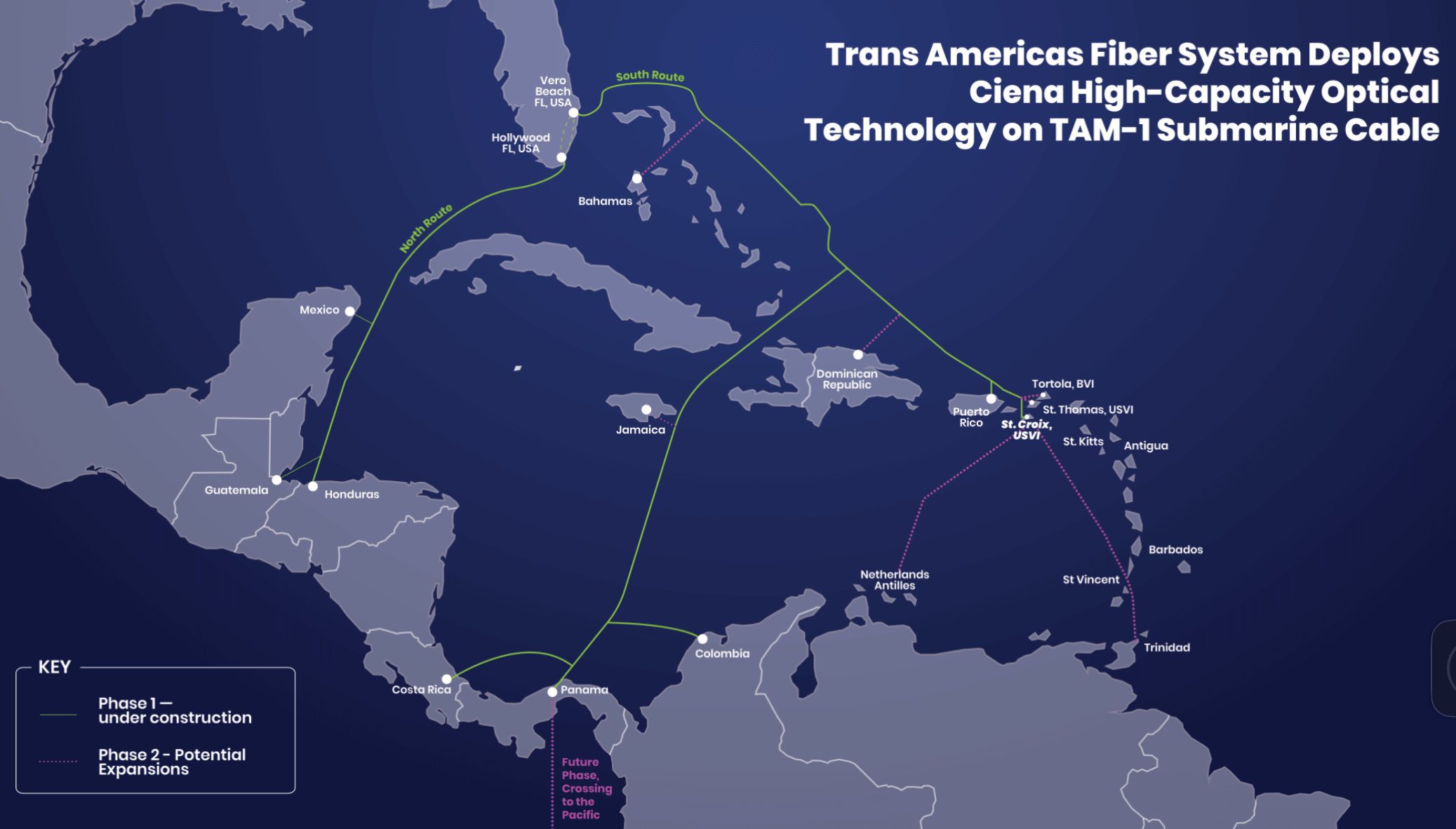
Trans Americas Fiber System (TAFS) has unveiled its TAM-1 subsea cable system — a 7,200-km, next-generation network connecting the U.S. to Mexico, Central America, Colombia, and the Caribbean. TAM-1 is the first open, neutral fiber system in decades to bridge these regions directly, built to support AI, cloud, 5G, and edge computing traffic with massive scalability and resilience.
The system will deliver more than 650 Tbps of total design capacity, configured across 24 fiber pairs southbound and 12 northbound. TAFS has partnered with Ciena to deploy its GeoMesh Extreme solution, powered by WaveLogic 6 Extreme coherent optics and the 6500 Reconfigurable Line System (RLS). This architecture supports spectrum sharing, open interconnection, and elastic scalability — allowing service providers to scale seamlessly as bandwidth demand accelerates across the Americas.
TAM-1 will feature two diverse subsea routes for resiliency and low latency. The northern route is expected to be Ready for Service (RFS) in Q4 2025, with the southern route following in Q1 2026. The system’s programmable design and automation capabilities position it to meet exponential growth in bandwidth demand from hyperscalers, carriers, and enterprises.
- 7,200-km dual-route subsea network linking the U.S., Mexico, Central America, Colombia, and the Caribbean
- More than 650 Tbps total capacity (24 fiber pairs southbound, 12 northbound)
- Powered by Ciena’s GeoMesh Extreme and WaveLogic 6 Extreme coherent technology
- Open, neutral architecture supporting spectrum sharing and scalable growth
- Northern route RFS: Q4 2025; Southern route RFS: Q1 2026
“At TAFS, we are leading a new generation of fluid connectivity for the Americas,” said Julio Bran, CEO of Trans Americas Fiber System. “TAM-1 is designed to disrupt the status quo, and together with Ciena, we are setting a new standard for connectivity in the region.”
🌐 Analysis: TAM-1 marks a major advance in subsea capacity for the Americas, positioning TAFS as a new neutral player in long-haul regional infrastructure. By adopting Ciena’s WaveLogic 6 Extreme technology — the same 1.6 Tbps-class optics now being deployed in hyperscale networks — TAFS joins a new wave of high-capacity builds redefining Latin American connectivity. The project also reflects the ongoing pivot toward open, programmable subsea architectures that enable spectrum sharing and faster service activation.