• Home
  • Events Calendar
  • Blueprint Guidelines
  • Privacy Policy
  • Subscribe to Daily Newsletter
  • NextGenInfra.io
No Result
View All Result
Converge Digest
Saturday, April 11, 2026
  • Home
  • Events Calendar
  • Blueprint Guidelines
  • Privacy Policy
  • Subscribe to Daily Newsletter
  • NextGenInfra.io
No Result
View All Result
Converge Digest
No Result
View All Result

Home » U.S. Taps Dell and NVIDIA to Build Doudna Supercomputer

U.S. Taps Dell and NVIDIA to Build Doudna Supercomputer

May 31, 2025
in All
A A

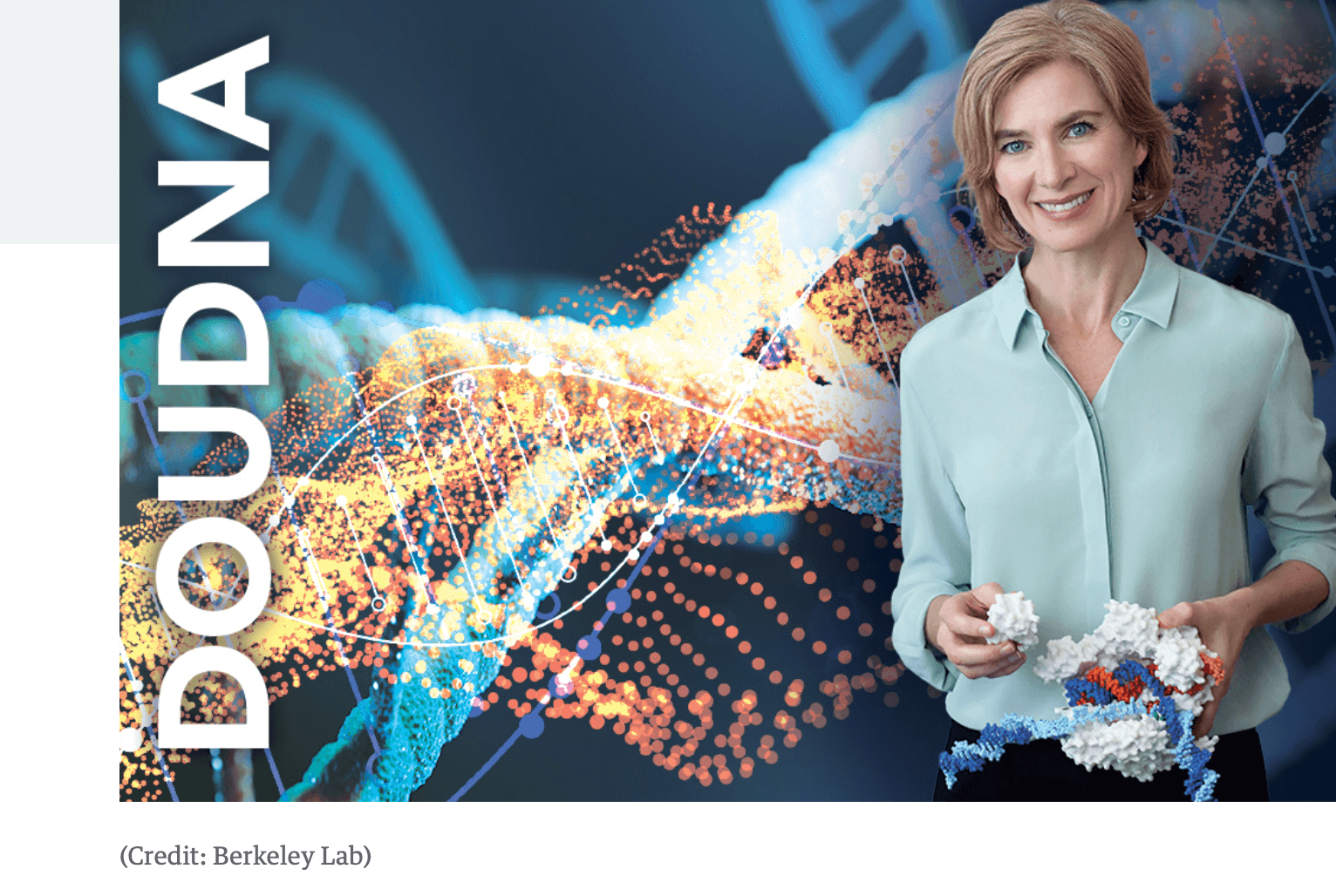
The U.S. Department of Energy (DOE) has awarded Dell Technologies a major contract to build NERSC-10—its next flagship supercomputer—at Lawrence Berkeley National Laboratory. Slated to come online in 2026, the new system, named Doudna in honor of CRISPR pioneer and Nobel laureate Jennifer Doudna, will be powered by Dell servers and NVIDIA’s forthcoming Vera Rubin platform, designed to handle large-scale simulation, data, and AI workloads.

Doudna will deliver over 10 times the performance of the current Perlmutter system at the National Energy Research Scientific Computing Center (NERSC). It will support AI training and inference at scale, advanced quantum simulation via CUDA-Q, and next-gen fusion research. The system will feature Dell’s latest liquid-cooled server architecture, NVIDIA’s Blackwell-based GPU-CPU nodes, and Quantum-X800 InfiniBand networking. A reconfigurable heterogeneous compute environment will enable real-time interactive computing and seamless data workflows across DOE facilities through ESnet.

The DOE highlighted the system as a strategic asset in the global AI race, with Secretary of Energy Chris Wright stating, “AI is the Manhattan Project of our time, and Doudna will help ensure America’s scientists have the tools they need to win the global race for AI dominance.” The system is expected to empower over 11,000 users across 800 projects with capabilities that compress “years of discovery into days,” according to NVIDIA CEO Jensen Huang.

  • DOE awards Dell Technologies the contract to build NERSC-10, named Doudna
  • System to deliver 10x performance over current Perlmutter supercomputer
  • Built with Dell ORv3 liquid-cooled servers and NVIDIA’s Vera Rubin platform
  • Enables high-performance computing, AI training/inference, and quantum simulation
  • Fully integrated with DOE science facilities via ESnet for near real-time workflows

“Doudna is a time machine for science — compressing years of discovery into days,” said Jensen Huang, founder and CEO of NVIDIA.

  • NVIDIA’s Vera Rubin platform, named after the astronomer who pioneered dark matter research, is the successor to the Blackwell architecture, set to launch in the second half of 2026. It combines the Rubin GPU and Vera CPU, manufactured using TSMC’s 3nm process, and features 8 stacks of HBM4 memory (up to 288GB) for enhanced AI and HPC workloads. The platform includes NVLink 6 switches with speeds up to 3600 GB/s and CX9 SuperNIC at 1600 Gb/s. The Vera Rubin NVL144 rack delivers 3.6 exaFLOPS of FP4 inference and 1.2 exaFLOPS of FP8 training, offering 3.3x the performance of the GB300 NVL72. A Rubin Ultra variant with 12 HBM4 stacks is planned for 2027, targeting even higher performance with up to 15 exaFLOPS of FP4 compute in the NVL576 configuration.

ShareTweetShare
Previous Post

Dell Accelerates AI Data Center Strategy with $12.1B in Q1 AI Server Orders

Next Post

HPE Doubles Distributed Switch Performance with Aruba CX 10040 + AMD DPUs

Jim Carroll

Jim Carroll

Editor and Publisher, Converge! Network Digest, Optical Networks Daily - Covering the full stack of network convergence from Silicon Valley

Related Posts

Cisco, G42, and AMD to Build AI Infrastructure in the UAE
AI Infrastructure

DigitalBridge Teams with KT for AI Data Centers in Korea

November 26, 2025
BerryComm Expands Central Indiana Fiber with Nokia
5G / 6G / Wi-Fi

Telefónica Germany Awards Nokia a 5-Year RAN Modernization Deal

November 26, 2025
AMD’s Compute + Pensando Network Architecture Powers Zyphra’s AI 
AI Infrastructure

AMD’s Compute + Pensando Network Architecture Powers Zyphra’s AI 

November 25, 2025
Bleu, the “Cloud de Confiance” from Capgemini and Orange
Clouds and Carriers

Orange Business Begins Migration of 70% of IT Infrastructure to Bleu Cloud

November 25, 2025
Dell’s server and networking sales rise 16% yoy
Financials

Dell Raises FY26 AI Infrastructure Outlook as AI Server Shipments Surge 150%

November 25, 2025
GlobalFoundries acquires Tagore Technology’s GaN IP
Optical

GlobalFoundries Acquires InfiniLink for Silicon-Photonics Expertise

November 25, 2025
Next Post
HPE Doubles Distributed Switch Performance with Aruba CX 10040 + AMD DPUs

HPE Doubles Distributed Switch Performance with Aruba CX 10040 + AMD DPUs

Categories

  • 5G / 6G / Wi-Fi
  • AI Infrastructure
  • All
  • Automotive Networking
  • Blueprints
  • Clouds and Carriers
  • Data Centers
  • Enterprise
  • Explainer
  • Feature
  • Financials
  • Last Mile / Middle Mile
  • Legal / Regulatory
  • Optical
  • Quantum
  • Research
  • Security
  • Semiconductors
  • Space
  • Start-ups
  • Subsea
  • Sustainability
  • Video
  • Webinars

Archives

Tags

5G All AT&T Australia AWS Blueprint columns BroadbandWireless Broadcom China Ciena Cisco Data Centers Dell'Oro Ericsson FCC Financial Financials Huawei Infinera Intel Japan Juniper Last Mile Last Mille LTE Mergers and Acquisitions Mobile NFV Nokia Optical Packet Systems PacketVoice People Regulatory Satellite SDN Service Providers Silicon Silicon Valley StandardsWatch Storage TTP UK Verizon Wi-Fi
Converge Digest

A private dossier for networking and telecoms

Follow Us

  • Home
  • Events Calendar
  • Blueprint Guidelines
  • Privacy Policy
  • Subscribe to Daily Newsletter
  • NextGenInfra.io

© 2025 Converge Digest - A private dossier for networking and telecoms.

No Result
View All Result
  • Home
  • Events Calendar
  • Blueprint Guidelines
  • Privacy Policy
  • Subscribe to Daily Newsletter
  • NextGenInfra.io

© 2025 Converge Digest - A private dossier for networking and telecoms.

This website uses cookies. By continuing to use this website you are giving consent to cookies being used. Visit our Privacy and Cookie Policy.
Go to mobile version