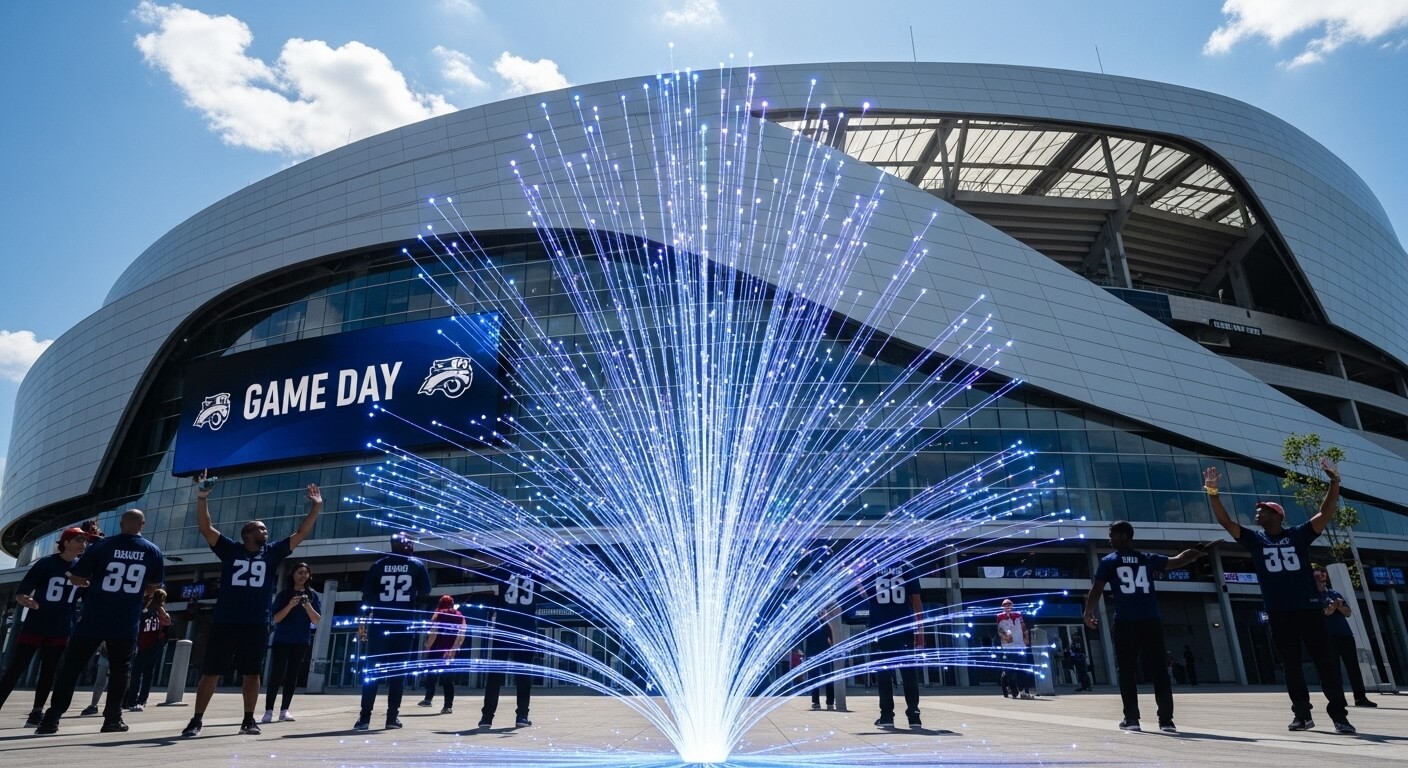
Verizon Business activated a new 100G optical ring connecting four Monumental Sports & Entertainment (MSE) sites, creating a unified broadcast and corporate network for the Washington Capitals, Wizards, Mystics, and Capital City Go-Go. According to a blog by Verizon, the dedicated 100G ring links Capital One Arena, MedStar Capitals Iceplex, MedStar Health Performance Center, and MSE’s broadcast headquarters to streamline content production ahead of the 2025–26 NHL and NBA seasons. The architecture supports both studio-grade media workflows and internal IT operations over a single, resilient optical foundation.
The private network enables MSE to shift toward centralized, remote production—reducing the number of on-site broadcast resources and allowing producers, editors, and engineers to work across multiple venues from a consolidated facility. The optical ring also supports higher-bandwidth feeds, multi-camera operations, and low-latency transport, which are becoming essential as sports organizations adopt IP-based broadcast systems and cloud-enabled workflows. The setup improves operational continuity as live events, practices, and studio programming move across locations without requiring truck-based infrastructure.
Verizon said the network underpins MSE’s broader digital transformation strategy, enabling more dynamic player and game content for Monumental Sports Network’s OTT platforms. The fiber backbone is designed to integrate with 5G connectivity for mobile workflows and future innovations in remote editing, AI-assisted production, and personalized fan experiences. MSE expects the 100G architecture to serve as its core broadcast engine for years to come.
• 100G optical ring connects Capital One Arena, MedStar training centers, and MSE HQ
• Supports centralized IP-based broadcast production and reduced on-site infrastructure
• Enables remote production models and integration with cloud and 5G workflows
• Optimizes content creation for Monumental Sports Network’s OTT and digital platforms
• Designed to enhance resiliency and operational continuity across the 2025–26 seasons
“The foundational investment in our network will enable the innovations of tomorrow and deliver a world-class, next-generation broadcast experience for our partners and fans,” said Charlie Myers, CTO, MSE.
🌐 Analysis
Sports media companies continue to migrate from truck-centric workflows to fully IP-based production as fiber capacity increases between venues. Verizon’s deployment aligns with similar 100G+ broadcast backbones rolling out across major U.S. stadiums and regional networks, many leveraging remote production to cut costs and support larger volumes of digital content. MSE’s adoption reflects a broader trend toward cloud-assisted and AI-enhanced sports workflows, with carriers expanding dedicated optical rings to support real-time media transport and future 2110 IP production models.