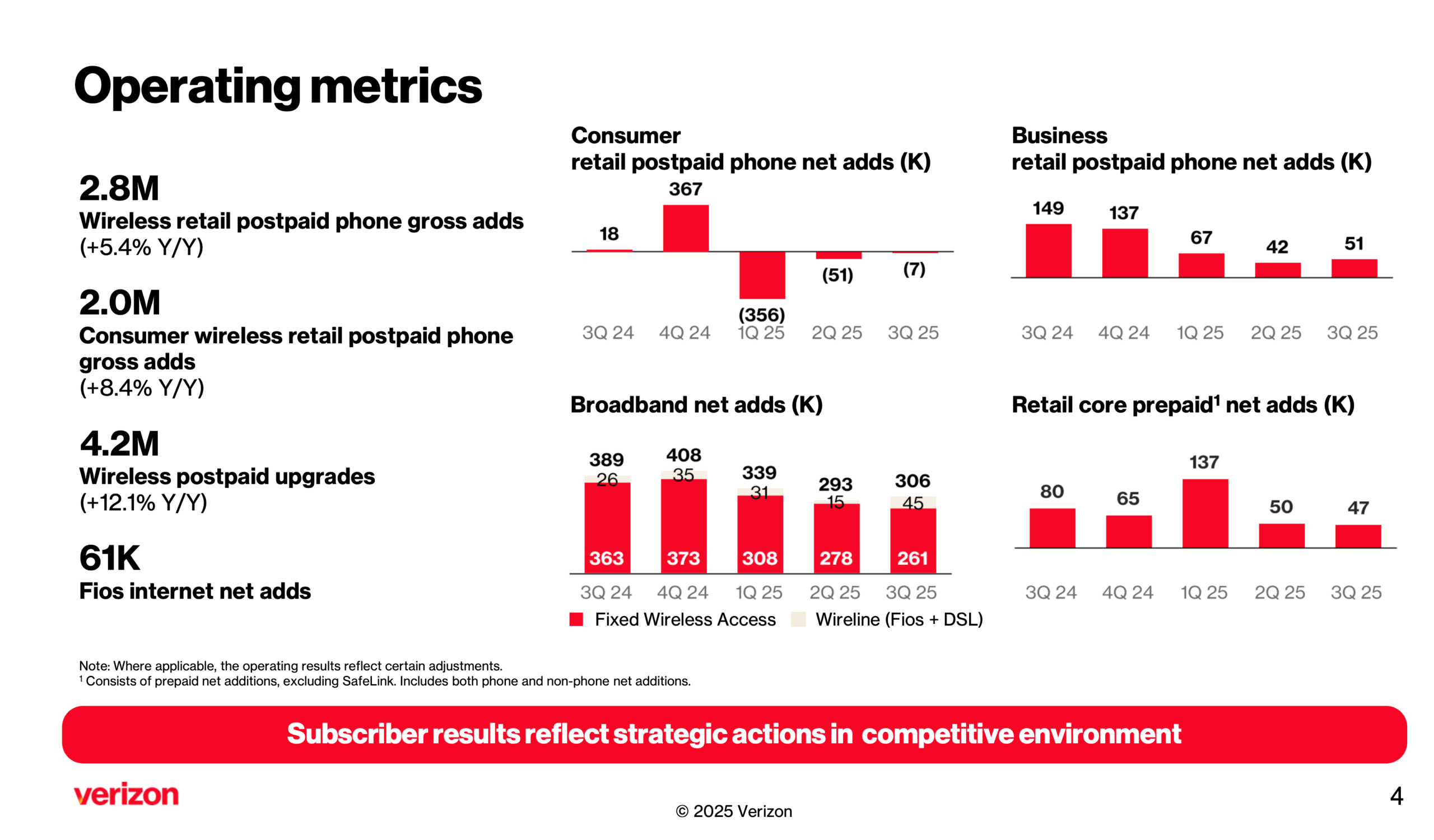
Verizon Communications reported Q3 2025 revenue of $33.8 billion, up 1.5% year over year, with wireless service revenue rising 2.1% to $21 billion. The company delivered 306,000 broadband net additions, including 261,000 from Fixed Wireless Access (FWA), bringing its total FWA base to 5.4 million subscribers. Fios internet added 61,000 subscribers—the strongest gain in two years—driving total broadband connections to 13.2 million, up 11% from last year.
CEO Dan Schulman, leading his first earnings call since taking over, outlined a multi-year transformation plan to reposition Verizon as a “customer-first” company, emphasizing profitable growth across mobility and broadband. He vowed to reduce costs, exit legacy businesses, and use AI to enhance customer experience and operational efficiency. Verizon’s acquisition of Frontier Communications remains on track for early 2026, which will expand its fiber footprint to roughly 29 million passings.
CFO Tony Skiadas said Verizon’s free cash flow reached $7 billion in Q3, up 17% year over year, with net unsecured debt reduced to $112 billion (2.2x adjusted EBITDA). The company expects full-year free cash flow between $19.5 billion and $20.5 billion and continues to prioritize debt reduction and dividend stability.
• Wireless service revenue grew 2.1% year over year; wireless equipment revenue rose 5.2%
• Consumer segment revenue increased 2.9% to $26.1 billion; Business revenue declined 2.8% to $7.1 billion
• Broadband net adds of 306,000 included 261,000 from FWA and 61,000 from Fios
• More than 18% of consumer postpaid customers now take a converged mobile + broadband offering
• Verizon announced a partnership with Tillman to expand Fios beyond its current footprint and plans to acquire Starry to enhance MDU broadband coverage
• Frontier acquisition approvals secured in 11 of 13 states; expected to close in Q1 2026
“We must redefine Verizon’s trajectory,” said Schulman. “This is not about incremental change. We will transform our cost structure and culture to compete effectively, delight customers, and deliver sustainable returns.”
🌐 Analysis: Schulman’s comments signal a strategic reset focused on convergence, customer retention, and AI-driven efficiency. Verizon’s growth in FWA remains a key differentiator as the company moves toward a blended fiber-wireless model. The planned integration of Frontier and partnership with Tillman indicate a major expansion of its fixed broadband strategy—aligning Verizon more closely with AT&T’s fiber ambitions and T-Mobile’s aggressive FWA push.
Verizon’s FWA momentum continues to be one of the standout growth stories in its broadband portfolio, accounting for 261,000 of the quarter’s 306,000 total broadband net adds. With nearly 5.4 million FWA subscribers generating over $3 billion in annualized revenue, Verizon is demonstrating that 5G-based fixed wireless can be both a scalable and profitable complement to fiber. The company views FWA as a long-term sustainable business, bolstered by efficient C-band deployment and rural reach where wired broadband options remain limited. Schulman’s emphasis on convergence—pairing mobile and home broadband—suggests Verizon will increasingly use FWA as an entry point for bundled services, particularly in areas beyond its fiber footprint. This positions Verizon to compete more directly with T-Mobile’s expanding 5G Home Internet offering while reinforcing its strategy to blend wireless scale with targeted fiber investment for nationwide broadband coverage.