• Home
  • Events Calendar
  • Blueprint Guidelines
  • Privacy Policy
  • Subscribe to Daily Newsletter
  • NextGenInfra.io
No Result
View All Result
Converge Digest
Friday, April 10, 2026
  • Home
  • Events Calendar
  • Blueprint Guidelines
  • Privacy Policy
  • Subscribe to Daily Newsletter
  • NextGenInfra.io
No Result
View All Result
Converge Digest
No Result
View All Result

Home » Verizon Deploys OpenStack NFV in 5 Data Centers

Verizon Deploys OpenStack NFV in 5 Data Centers

April 28, 2016
in All
A A

Verizon has completed a Network Function Virtualization OpenStack cloud deployment across five of its U.S. data centers.

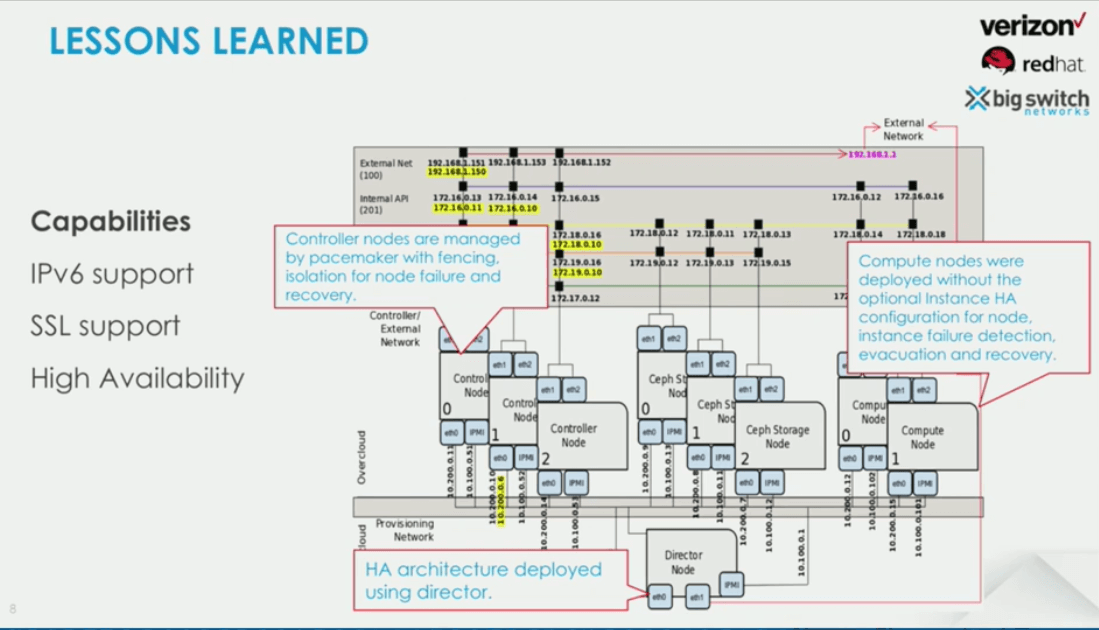
Verizon said its NFV project, which began in 2015, created a production design based on a core and pod architecture that provides hyperscale capabilities. The project is based on OpenStack with Red Hat Ceph Storage and a spine-leaf fabric for each pod controlled through a Neutron plugin to Red Hat OpenStack Platform. The multi-vendor deployment leverages Big Switch’s Big Cloud Fabric for SDN controller software managing Dell switches, which are orchestrated by Red Hat OpenStack Platform.

Verizon said the OpenStack pod-based design that went from concept to deployment of more than 50 racks in five production data centers in less than nine months. Rollouts are currently in progress in additional domestic data center and aggregation sites, with international locations to be deployed over the next several months. The design also will be adopted in edge network sites by the end of the year.

Architecturally, the large scale NFV deployment had five key needs, which were identified early in the project:

  • Resiliency at Scale – The design followed a hyperscale-inspired “core and pod” approach with a 12-rack pod design replicated at data centers across the United States.
  • No Bandwidth Bottlenecks – A modern leaf-spine Clos design, using centralized SDN control designed to take the network from spine to leaf to vSwitch and avoid bandwidth bottlenecks.
  • Logical Network Design Flexibility – The pod design accommodates unique NFV workloads with unique logical network requirements that share the same physical leaf/spine fabric and vSwitches.
  • Reduced Operational Complexity – Operational complexity is reduced through a simplified lifecycle management of the network control systems relative to the OpenStack control systems.
  • Integrated Security and Visibility – The NFV Pod is designed to be compliant and secure against intrusions and other threats, monitoring fabric was used to monitor intra-pod traffic and inline traffic.

“Building on our history of innovation, this NFV project is another step in building Verizon’s next-generation network — with implications for the industry. New and emerging applications are highlighting the need for collaborative research and development in technologies like NFV. We consider this achievement to be foundational for building the Verizon cloud that serves our customers’ needs anywhere, anytime, any app.”  Adam Koeppe, vice president, network technology planning, Verizon

http://www.verizon.com/about/news/verizon-launches-industry-leading-large-openstack-nfv-deployment

A 35 minute presentation from this week’s OpenStack Summit in Austin is posted here: https://youtu.be/1aVB3QvEYcI

Tags: Big SwitchBlueprint columnsNFVOpenStackRed HatVerizon
ShareTweetShare
Previous Post

Verizon Reports 57 Incidents of Sabotage in 2 Weeks

Next Post

LeEco Opens Autonomous Driving R&D Center in San Jose

Staff

Staff

Related Posts

Verizon Builds 100G Optical Backbone for Monumental Sports & Entertainment
All

Verizon Builds 100G Optical Backbone for Monumental Sports & Entertainment

November 13, 2025
Verizon Business and AWS Sign New AI Fiber Network Deal
Clouds and Carriers

Verizon Business and AWS Sign New AI Fiber Network Deal

November 3, 2025
Verizon CEO Schulman Outlines Network Growth and Turnaround Strategy
Clouds and Carriers

Verizon CEO Schulman Outlines Network Growth and Turnaround Strategy

October 30, 2025
Australia’s nbn hits new traffic peak – 26.76 Tbps
Last Mile / Middle Mile

Verizon Expands Fiber Reach with Tillman Global

October 27, 2025
Verizon: AI-Powered Mobile Threats Escalate
5G / 6G / Wi-Fi

Verizon: AI-Powered Mobile Threats Escalate

October 24, 2025
AST SpaceMobile Ramps Toward 60 Satellites with Fast Launch Cadence
Space

AST SpaceMobile and Verizon Sign Definitive Agreement for Space-Based Cellular Broadband

October 8, 2025
Next Post
LeEco Opens Autonomous Driving R&D Center in San Jose

LeEco Opens Autonomous Driving R&D Center in San Jose

Please login to join discussion

Categories

  • 5G / 6G / Wi-Fi
  • AI Infrastructure
  • All
  • Automotive Networking
  • Blueprints
  • Clouds and Carriers
  • Data Centers
  • Enterprise
  • Explainer
  • Feature
  • Financials
  • Last Mile / Middle Mile
  • Legal / Regulatory
  • Optical
  • Quantum
  • Research
  • Security
  • Semiconductors
  • Space
  • Start-ups
  • Subsea
  • Sustainability
  • Video
  • Webinars

Archives

Tags

5G All AT&T Australia AWS Blueprint columns BroadbandWireless Broadcom China Ciena Cisco Data Centers Dell'Oro Ericsson FCC Financial Financials Huawei Infinera Intel Japan Juniper Last Mile Last Mille LTE Mergers and Acquisitions Mobile NFV Nokia Optical Packet Systems PacketVoice People Regulatory Satellite SDN Service Providers Silicon Silicon Valley StandardsWatch Storage TTP UK Verizon Wi-Fi
Converge Digest

A private dossier for networking and telecoms

Follow Us

  • Home
  • Events Calendar
  • Blueprint Guidelines
  • Privacy Policy
  • Subscribe to Daily Newsletter
  • NextGenInfra.io

© 2025 Converge Digest - A private dossier for networking and telecoms.

No Result
View All Result
  • Home
  • Events Calendar
  • Blueprint Guidelines
  • Privacy Policy
  • Subscribe to Daily Newsletter
  • NextGenInfra.io

© 2025 Converge Digest - A private dossier for networking and telecoms.

This website uses cookies. By continuing to use this website you are giving consent to cookies being used. Visit our Privacy and Cookie Policy.
Go to mobile version