Verizon has signed a new commercial fiber agreement with Tillman Global Holdings’ Eaton Fiber to deliver high-speed broadband to homes outside its existing FiOS markets. The deal complements Verizon’s pending acquisition of Frontier Communications and reinforces its nationwide strategy to blend mobility and broadband through a fiber-first approach.
Under the agreement, Eaton Fiber will finance, construct, and maintain new fiber networks, while Verizon will handle sales, marketing, and customer support. Verizon will also gain exclusive rights to retail residential broadband services on the new network during construction and for a defined period afterward, giving it a competitive advantage in capturing early subscribers.
Verizon said the arrangement will accelerate market expansion into underserved areas and provide customers with access to its FiOS service, known for symmetrical multi-gigabit speeds and low latency. The partnership extends Verizon’s broadband presence beyond its traditional Northeastern and Mid-Atlantic base, leveraging third-party capital to scale efficiently.
- The deal targets new geographic markets outside Verizon’s and Frontier’s current FTTH footprint.
- Eaton Fiber, a Tillman affiliate, will fund, build, and operate the network infrastructure.
- Verizon will be the exclusive residential broadband retailer during the rollout period.
- The partnership supports Verizon’s “broadband and mobility convergence” strategy.
- The expansion aligns with Verizon’s ongoing acquisition of Frontier’s fiber assets.
“Our strategy is clear: lead the market in premium mobility and broadband convergence, and fiber is the foundation of that leadership,” said Sowmyanarayan Sampath, Executive Vice President for Verizon and CEO for Verizon Consumer.
🌐 Analysis: Tillman Global Holdings is a privately held infrastructure investment and operating company based in New York City, founded and led by Sanjiv Ahuja, former CEO of Orange Group and LightSquared. The company focuses on building and financing digital and energy infrastructure assets worldwide, including telecommunications towers, fiber networks, and data centers. Through its portfolio companies—such as Tillman Infrastructure, Tillman Networks, and Eaton Fiber—the group develops and operates thousands of wireless towers and transport networks across the United States, Europe, and emerging markets. Tillman is backed by long-term institutional investors including Carlyle Group, J.P. Morgan Asset Management, and Northleaf Capital Partners, providing access to multi-billion-dollar capital for expansion. Eaton Fiber, the subsidiary partnering with Verizon, represents Tillman’s push into the wholesale fiber-to-the-premises segment, leveraging its experience deploying tower and edge assets for major mobile operators. The company maintains a strong balance sheet and reputation for asset-backed financing, emphasizing sustainable, scalable infrastructure to meet the growing demands of broadband and 5G networks.
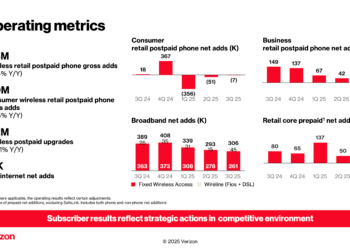
Verizon currently serves roughly 7.5 million FiOS Internet customers, a figure that has remained relatively steady in recent quarters as expansion slowed within its legacy territory. The new Eaton Fiber partnership signals a shift toward growth through wholesale and build-to-lease models, rather than direct network construction.
Verizon’s planned acquisition of Frontier Communications, announced in September 2024 for approximately US $20 billion (including debt), is expected to close in Q1 2026 pending regulatory approvals. The all-cash deal, valued at US $38.50 per share, would add Frontier’s ~7.2 million fiber-locations footprint and ~2.2 million fiber subscribers across 25 states to Verizon’s existing ~7.5 million FiOS connections concentrated in the Northeast and Mid-Atlantic. The combination would expand Verizon’s fiber reach into major new territories across the Midwest, Texas, and California, where Frontier has been upgrading its legacy copper network to fiber. By integrating these assets, Verizon aims to accelerate its national broadband coverage and strengthen its fixed-wireless and fiber convergence strategy against AT&T and regional cable operators.