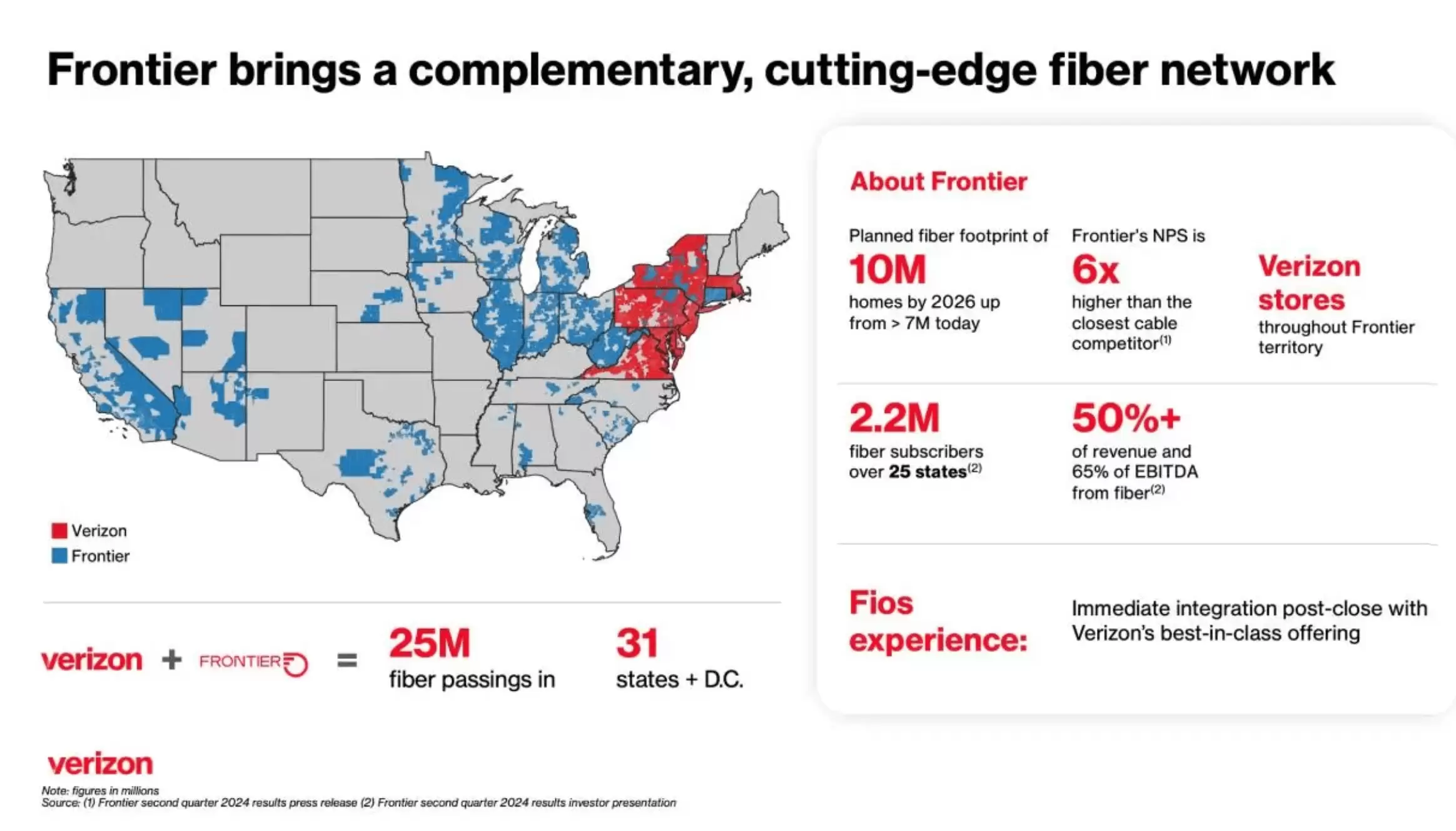
Verizon Communications agreed to acquire Frontier Communications in an all-cash deal valued at $20 billion. The acquisition is expected to expand Verizon’s fiber network to over 25 million premises across 31 states and Washington, D.C. Frontier, a leading fiber internet provider, currently serves 2.2 million fiber subscribers and is on track to extend its network to an additional 2.8 million locations by 2026.
Frontier Communications, originally founded in 1935 as Citizens Utilities Company, began as a utility service provider but shifted its focus to telecommunications in the 1980s. It rebranded to Frontier Communications in 2008, reflecting its growing telecom operations. In 2009, Frontier made a major move by acquiring Verizon’s rural wireline assets in 14 states for $8.6 billion, significantly expanding its broadband and telecommunications reach. This was followed by a 2015 deal in which Frontier purchased additional wireline assets from Verizon in California, Texas, and Florida for $10.54 billion, further cementing its position in the market. However, financial struggles, including high debt from these acquisitions, led Frontier to file for bankruptcy in 2020. After emerging from bankruptcy in 2021, Frontier focused on expanding its fiber network, positioning itself as a major player in rural broadband .
Frontier has invested $4.1 billion into upgrading and expanding its fiber network over the past four years, generating more than half of its revenue from fiber services. With this acquisition, Verizon aims to integrate Frontier’s fiber assets with its own, enhancing its ability to deliver premium broadband and mobility services to a broader customer base. The transaction is also expected to generate $500 million in annual cost synergies.
Verizon CEO Hans Vestberg emphasized the strategic fit of the acquisition, stating that it strengthens Verizon’s leadership in fiber infrastructure. “The acquisition of Frontier is a strategic fit. It will build on Verizon’s two decades of leadership at the forefront of fiber and is an opportunity to become more competitive in more markets throughout the United States, enhancing our ability to deliver premium offerings to millions more customers across a combined fiber network.”
“Less than four years ago, we set out an ambitious plan to Build Gigabit America, the digital infrastructure this country needs to thrive for generations to come,” said Nick Jeffery, President and CEO of Frontier. “Today’s announcement is recognition of our progress building a best-in-class fiber network and delivering reliable, high-speed broadband to millions of customers across the country. It’s also a vote of confidence for the future of fiber. I am confident that this delivers a significant and certain cash premium to Frontier’s shareholders, while creating exciting new opportunities for our employees and expanding access to reliable connectivity for more Americans.”
Key Points:
- Verizon to acquire Frontier for $20 billion.
- Deal expands Verizon’s fiber reach to 25 million premises in 31 states.
- Verizon currently serves 7.4 million FiOS fiber subscribers.
- Frontier will add 2.2 million fiber subscribers
- Acquisition expected to generate $500 million in annual cost synergies.
- Frontier has invested $4.1 billion in fiber upgrades over the last four years.
- Verizon reaffirmed its full-year 2024 guidance.
- The deal effectively reverses deals in 2009 and 2015 in which Verizon sold network assets to Frontier
“The acquisition of Frontier is a strategic fit…enhancing our ability to deliver premium offerings to millions more customers,” said Verizon Chairman and CEO Hans Vestberg.

From 2015