• Home
  • Events Calendar
  • Blueprint Guidelines
  • Privacy Policy
  • Subscribe to Daily Newsletter
  • NextGenInfra.io
No Result
View All Result
Converge Digest
Friday, April 10, 2026
  • Home
  • Events Calendar
  • Blueprint Guidelines
  • Privacy Policy
  • Subscribe to Daily Newsletter
  • NextGenInfra.io
No Result
View All Result
Converge Digest
No Result
View All Result

Home » ViaSat-3 brings terabit class switching to geostationary orbit

ViaSat-3 brings terabit class switching to geostationary orbit

April 30, 2023
in Space
A A

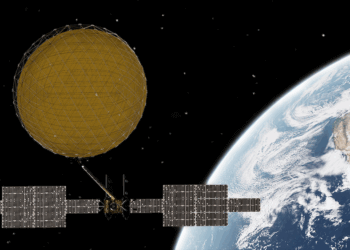
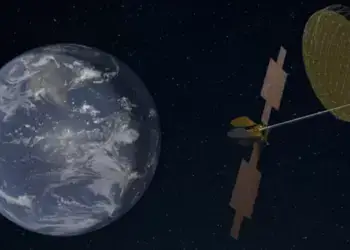
SpaceX successfully launched ViaSat-3 Americas satellite to geostationary orbit aboard a Falcon Heavy rocket from Kennedy Space Center in Florida. Also on board this mission was Astranis’s first MicroGEO satellite and Gravity Space’s GS-1 satellite. 

ViaSat-3 Americas is the first of three geostationary satellites that will form a new constellation. Each of the satellites offers over 1 Tbps of onboard switching capacity with the ability to redirect bandwidth as needed. Each of the satellites in the upcoming ViaSat-3 global constellation is expected to be able to temporarily concentrate capacity at geographic points of demand, reducing coverage to places that need less capacity. Enormous solar panels will offer 25 kilowatts of power.

ViaSat-3 also features anti-jamming capabilities for government and defense applications.

“That additional capacity gives us all kinds of leverage to grow the business and provide even better services on the commercial side, and the military and defense side as well,” said Craig Miller, president of Viasat’s government services segment. “The ViaSat-3 constellation will give us global capability and opens the door to a wider variety of government missions.”

“Jamming is highly successful and commonly used in war time,” Miller said. “ViaSat-3 is designed to be incredibly difficult to disrupt. So you’re going to have a system that has a large amount of capacity that is designed to work even when our adversaries are trying to make it stop working. That’s really important, and it will set ViaSat-3 apart from basically all other systems. ViaSat-3 is expected to outperform even some purpose-built military satellites in that regard. That’s a really exciting capability.”

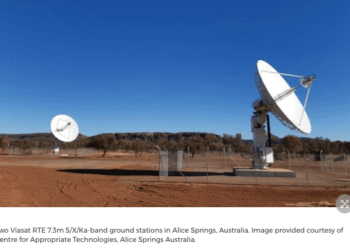
ViaSat-3’s ground network will be composed of hundreds of Satellite Access Nodes (SANS), ensuring redundancy.

SpaceX noted that one of the side boosters on this mission previously supported Arabsat-6A, STP-2, COSMO-SkyMed Second Generation FM2, KPLO, and three Starlink missions, and the second previously supported launch of Arabsat-6A and STP-2.


Tags: ViaSat
ShareTweetShare
Previous Post

SES launches 2 more O3b mPOWER satellites

Next Post

What’s Next for NaaS?

Jim Carroll

Jim Carroll

Editor and Publisher, Converge! Network Digest, Optical Networks Daily - Covering the full stack of network convergence from Silicon Valley

Related Posts

ViaSat-3 F2 Launches, Promising Terabit-Class GEO Capacity for the Americas
Space

ViaSat-3 F2 Launches, Promising Terabit-Class GEO Capacity for the Americas

November 13, 2025
Japan plans Space-based Direct-to-Device Service
Space

Viasat Targets LEO/MEO Market with Modular HaloNet Connectivity 

August 11, 2025
ViaSat-3 Americas satellite fails to deploy reflector
Space

ViaSat-3 Americas satellite fails to deploy reflector

July 12, 2023
Viasat completes Inmarsat acquisition
Space

Viasat completes Inmarsat acquisition

June 4, 2023
Viasat connects 5 Earth stations to Microsoft Azure
Clouds and Carriers

Viasat connects 5 Earth stations to Microsoft Azure

April 11, 2023
Viasat debuts military Free Space Optical
Optical

Viasat debuts military Free Space Optical

April 9, 2023
Next Post
What’s Next for NaaS?

What's Next for NaaS?

Categories

  • 5G / 6G / Wi-Fi
  • AI Infrastructure
  • All
  • Automotive Networking
  • Blueprints
  • Clouds and Carriers
  • Data Centers
  • Enterprise
  • Explainer
  • Feature
  • Financials
  • Last Mile / Middle Mile
  • Legal / Regulatory
  • Optical
  • Quantum
  • Research
  • Security
  • Semiconductors
  • Space
  • Start-ups
  • Subsea
  • Sustainability
  • Video
  • Webinars

Archives

Tags

5G All AT&T Australia AWS Blueprint columns BroadbandWireless Broadcom China Ciena Cisco Data Centers Dell'Oro Ericsson FCC Financial Financials Huawei Infinera Intel Japan Juniper Last Mile Last Mille LTE Mergers and Acquisitions Mobile NFV Nokia Optical Packet Systems PacketVoice People Regulatory Satellite SDN Service Providers Silicon Silicon Valley StandardsWatch Storage TTP UK Verizon Wi-Fi
Converge Digest

A private dossier for networking and telecoms

Follow Us

  • Home
  • Events Calendar
  • Blueprint Guidelines
  • Privacy Policy
  • Subscribe to Daily Newsletter
  • NextGenInfra.io

© 2025 Converge Digest - A private dossier for networking and telecoms.

No Result
View All Result
  • Home
  • Events Calendar
  • Blueprint Guidelines
  • Privacy Policy
  • Subscribe to Daily Newsletter
  • NextGenInfra.io

© 2025 Converge Digest - A private dossier for networking and telecoms.

This website uses cookies. By continuing to use this website you are giving consent to cookies being used. Visit our Privacy and Cookie Policy.
Go to mobile version