Viasat has introduced its HaloNet portfolio, a modular set of near-Earth communications capabilities that unifies space and terrestrial connectivity for government and commercial missions. Developed by Viasat Government and the company’s Defense and Advanced Technologies unit, HaloNet is designed to provide multi-orbit, multi-band connectivity for missions in low Earth orbit (up to 1,100 km) and medium Earth orbit. The system supports simultaneous links to thousands of space vehicles across all orbital inclinations, including polar and retrograde, enabling secure, resilient, and responsive space-to-ground communications.
HaloNet services include telemetry, tracking, and command (TT&C) relay over Viasat’s L-band network; high-capacity Ka-band relay for large payload data transfers; launch-phase telemetry relay; direct-to-Earth (DTE) services through Viasat’s Ground Station as a Service (GSaaS) platform; and mobile, field-deployable gateways for command and control. Depending on mission needs, HaloNet can dynamically route data via L-band, Ka-band, or optical links, delivering from tens of Kbps to over 10 Gbps. The portfolio is aimed at meeting the growing demand for agile, reliable, and secure communications infrastructure for real-time satellite operations, scientific missions, and defense requirements.
“Customers need agile, reliable, and secure communications infrastructure that can support real-time command and control and data transport needs,” said Craig Miller, President, Viasat Government. “Our HaloNet portfolio enables us to continue meeting these evolving near-Earth mission communications needs, as well as government customers’ capability requirements for critical scientific and defense missions.”
• Supports LEO and MEO missions with simultaneous connectivity for thousands of satellites
• Offers GEO relay and DTE services with global ground station coverage across six continents
• Service tiers include TT&C relay, launch-phase telemetry relay, high-capacity data relay, and mobile command and control
• Multi-band transport via L-band, Ka-band, or optical links, with speeds up to 10+ Gbps
• Designed for both government and commercial satellite operators
Viasat’s Current Assets and Financials
Viasat operates a mix of Ka-band, L-band, and hybrid satellites, as well as a global ground station network:
- Current GEO Fleet: ViaSat-1, WildBlue-1, Anik-F2, and ViaSat-2, supporting Ka-band services for broadband and government use.
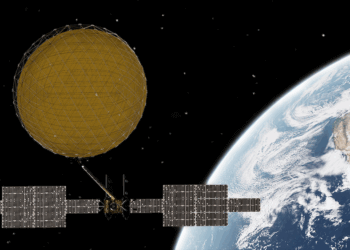
- ViaSat-3 Constellation: Planned to comprise three terabit-class GEO satellites covering the Americas (F1 – launched May 2023, but with reduced capacity), EMEA (F2 – expected H1 2025), and APAC (F3 – planned). These satellites are expected to play a major role in HaloNet’s GEO relay capabilities.
- Inmarsat L-band Fleet: Acquired in 2023, providing secure, low-latency global coverage for TT&C and narrowband data services.
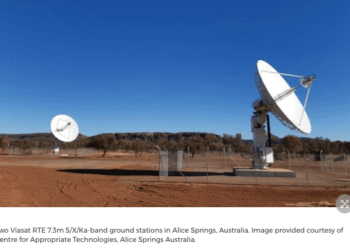
- Global Ground Infrastructure: Ground Station as a Service (GSaaS) network spanning six continents, enabling direct-to-Earth communications.
Financial Overview (FY2024 / latest available):
- Revenue: Approximately $4.3 billion, driven by Government Systems, Satellite Services, and Commercial Networks.
- Government Systems: Significant contributor, buoyed by defense and mobility contracts.
- Net Income: Impacted by ViaSat-3 F1 impairment charges; core operations remain profitable in government and mobility segments.
- Debt & Capital Investments: Elevated due to ViaSat-3 program and Inmarsat acquisition; company is focused on monetizing new capacity and integrating global assets.
🌐 Why it Matters
As LEO and MEO satellite deployments scale, secure and flexible ground-to-space communications are becoming critical for both government and commercial missions. HaloNet positions Viasat to capitalize on this demand by leveraging its expanded post-Inmarsat asset base, including L-band, Ka-band, and global ground stations. Integration with the ViaSat-3 constellation could provide higher capacity and lower latency options, strengthening Viasat’s competitiveness in the growing multi-orbit satcom market.