Toronto-based quantum computing startup Xanadu has achieved a major milestone with the first-ever generation of error-resistant photonic qubits on an integrated chip platform. The company published the breakthrough—an essential building block for fault-tolerant quantum systems—in Nature, marking a key advancement in its mission to build a modular and scalable photonic quantum computer.
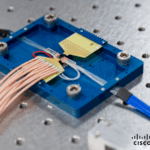
The experiment demonstrated the generation of Gottesman–Kitaev–Preskill (GKP) states, which encode quantum information in superpositions of many photons. These states are compatible with room-temperature operations and standard fiber networking, offering a practical path toward scalable, networked quantum systems. Xanadu’s custom-built platform includes ultra-low-loss silicon nitride waveguides fabricated on 300mm wafers, in-house optical packaging, and photon-number-resolving detectors with over 99% efficiency.
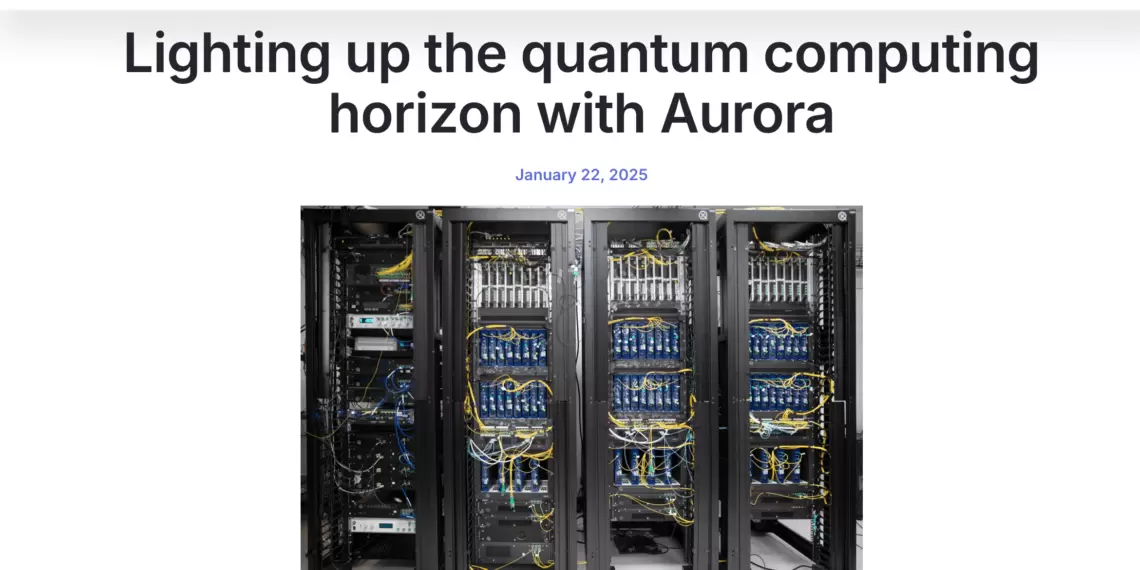
This achievement follows the unveiling of Aurora, Xanadu’s photonic quantum system architecture, which integrates all the components required for scalable and networked quantum computing. With this latest demonstration, Xanadu moves closer to realizing fault-tolerant systems by addressing loss reduction across the photonic stack.
Founded in 2016 by CEO Christian Weedbrook, a physicist with a background from the University of Queensland and a postdoctoral fellowship at the University of Toronto, Xanadu has raised over $250 million from investors including Georgian, Bessemer Venture Partners, OMERS Ventures, and Honeywell Ventures. The company is a leader in photonic quantum computing and is also the main developer of PennyLane, an open-source software framework for quantum machine learning and hybrid quantum-classical applications.
- Generated GKP states on-chip—first demonstration of this error-resistant photonic qubit architecture
- Integrated custom 300mm silicon nitride photonic chips with ultra-low-loss waveguides
- Achieved >99% efficiency in photon-number-resolving detectors
- Advances follow the launch of Xanadu’s Aurora system for scalable, modular quantum networks
- Core software includes PennyLane, a widely used tool in quantum AI research
- HQ: Toronto, Canada; Founded: 2016; CEO: Christian Weedbrook
- Total funding: $250M+; Backers include Georgian, Bessemer, OMERS, and Honeywell Ventures
“GKP states are, in a sense, the optimal photonic qubit, since they enable logic gates and error correction at room temperature and using relatively straightforward, deterministic operations,” said Zachary Vernon, CTO of Hardware at Xanadu.