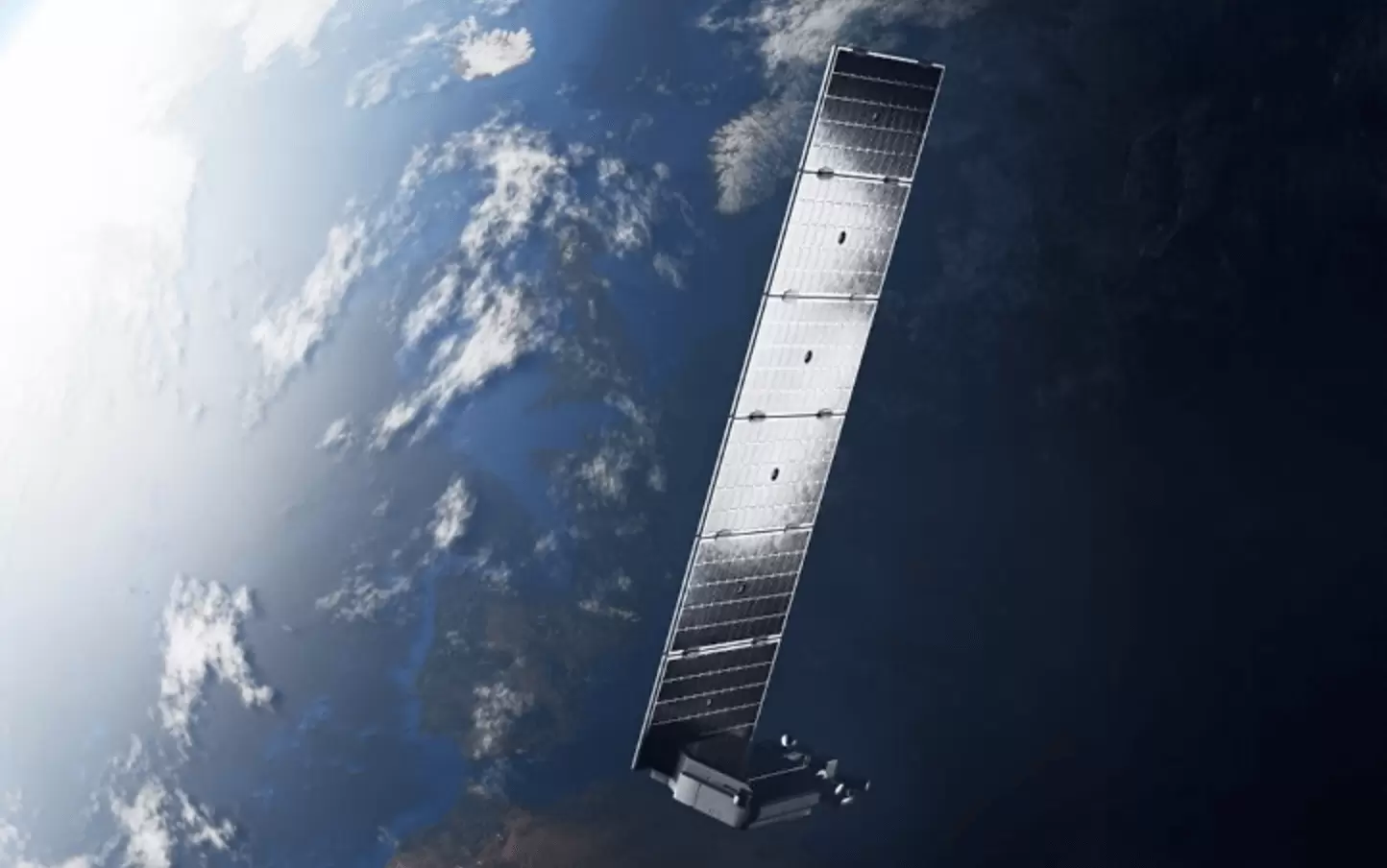
S-band spectrum delivers better propagation, enabling direct links to unmodified LTE/5G smartphones
SpaceX struck a $17 billion agreement with EchoStar to acquire its U.S. AWS-4 and H-block spectrum licenses, along with global MSS rights, enabling the next phase of Starlink Direct to Cell. The deal includes up to $8.5 billion in cash and $8.5 billion in SpaceX stock, plus funding of $2 billion in EchoStar debt interest payments through 2027. In parallel, EchoStar’s Boost Mobile subscribers will gain long-term access to SpaceX’s Direct to Cell service via EchoStar’s cloud-native 5G core.
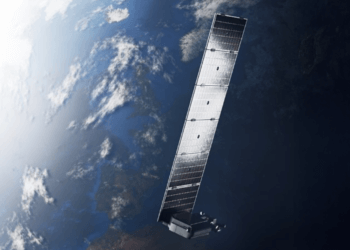
Since 2024, SpaceX has deployed over 600 Starlink Direct to Cell satellites, now offering the largest 4G footprint worldwide with more than six million users. Operating at 360 km altitude and tied into Starlink’s 8,000-satellite laser mesh, the system already supports messaging, video calls, and apps on standard LTE phones without modification. The next-generation constellation, powered by SpaceX-designed silicon and phased arrays, will leverage exclusive spectrum to deliver a 20x per-satellite throughput boost and overall system capacity 100x greater than the current generation. In most regions, this will enable full 5G cellular service comparable to terrestrial networks.
The service is positioned for global expansion through partnerships with operators such as T-Mobile, Optus, Rogers, KDDI, Telstra, Salt, Entel, One New Zealand, and Kyivstar. Starlink Direct to Cell has already proven vital in disaster recovery, powering communications for more than 1.5 million people during recent U.S. hurricanes and floods. The new spectrum deal is expected to close after regulatory review, with EchoStar applying proceeds toward debt reduction and ongoing operations.
• SpaceX to acquire EchoStar AWS-4 and H-block spectrum licenses for $17B (cash + stock)
• EchoStar Boost Mobile subscribers to gain access to Starlink Direct to Cell
• Over 600 Direct to Cell satellites already operational, covering five continents
• New constellation to support 20x throughput per satellite, 100x system capacity increase
• Partnerships in U.S., Australia, Canada, Japan, Switzerland, Chile, Peru, New Zealand, Ukraine
Hamid Akhavan, president & CEO of EchoStar, said: “This transaction with SpaceX continues our legacy of putting the customer first as it allows for the combination of AWS-4 and H-block spectrum from EchoStar with the rocket launch and satellite capabilities from SpaceX to realize the direct-to-cell vision in a more innovative, economical and faster way for consumers worldwide.”
🌐 Analysis:The AWS-4 and PCS H-block spectrum represent valuable mid-band assets with strong propagation and capacity characteristics. AWS-4 refers to 2×20 MHz blocks in the 2 GHz range (2000–2020 MHz uplink and 2180–2200 MHz downlink), originally allocated for Mobile Satellite Service (MSS) but later authorized by the FCC for terrestrial mobile broadband under flexible use rules. The PCS H-block consists of 2×5 MHz (1915–1920 MHz uplink and 1995–2000 MHz downlink) directly adjacent to Sprint/T-Mobile’s PCS G-block spectrum, making it well-suited for integration into LTE and 5G networks. Together, the 50 MHz of exclusive S-band spectrum provides SpaceX with globally harmonized frequencies that can support both wide-area coverage and higher throughput when paired with advanced 5G-optimized satellite waveforms and phased-array antenna technology.
Global MSS rights give SpaceX the ability to harmonize service worldwide, reducing the need for fragmented regional spectrum solutions.
This spectrum transaction marks a pivotal shift in the direct-to-phone race. For SpaceX, it consolidates control of U.S. S-band and global MSS spectrum—key enablers of performance and regulatory certainty in satellite-to-cellular services. SpaceX has systematically built momentum in this domain through partnerships with mobile operators worldwide. The first major breakthrough came with T-Mobile in August 2022, when the companies unveiled plans to use Starlink for text messaging in coverage gaps. Since then, SpaceX has struck deals with Optus and Telstra in Australia, Rogers in Canada, KDDI in Japan, Salt in Switzerland, Entel in Chile and Peru, One New Zealand, and Kyivstar in Ukraine. Collectively, these partnerships put SpaceX on track to deliver service across multiple continents without needing to negotiate retail distribution on its own.
SpaceX’s technical edge comes from its unmatched launch cadence and vertically integrated manufacturing. The company has deployed more than 8,000 satellites in orbit and adds hundreds more each quarter. Falcon 9’s regular tempo has made satellite constellations feasible at scale, while the upcoming Starship vehicle could accelerate deployments dramatically. With a payload capacity exceeding 100 metric tons, Starship can carry dozens of next-generation Direct to Cell satellites per launch, each more capable than its predecessors thanks to custom silicon and phased arrays. This combination of spectrum, satellite technology, and heavy-lift launch capacity positions SpaceX to scale service at a pace and cost no rival can currently match.
For EchoStar, the deal marks the end of a long strategic arc. The company, through its DISH Network roots, once sought to become the fourth U.S. mobile operator by combining spectrum holdings with a greenfield 5G build. But financial pressures, debt load, and the capital intensity of competing with AT&T, Verizon, and T-Mobile made that vision increasingly unsustainable. Just last month, EchoStar finalized a new arrangement with T-Mobile to transition Boost Mobile into a full MVNO, effectively abandoning its earlier standalone network ambitions. The sale of AWS-4 and H-block spectrum removes lingering FCC concerns, relieves debt obligations, and refocuses the company on leveraging partnerships rather than building its own infrastructure. By tying Boost subscribers into Starlink Direct to Cell, EchoStar gains a differentiator in prepaid wireless at a time when competitive intensity in the U.S. market is peaking.
The outcome is a reshaping of the competitive landscape: SpaceX takes control of premium spectrum assets to drive global satellite-cellular convergence, while EchoStar exits the operator race and repositions as a service aggregator. Both companies benefit—SpaceX by securing scarce spectrum to pair with its manufacturing and launch dominance, EchoStar by reducing leverage and aligning Boost Mobile with a uniquely global satellite offering.
Spectrum Comparison: Starlink Ku/Ka vs. Direct to Cell S-band
| Feature | Ku/Ka-band (Starlink Broadband) | AWS-4 / H-block S-band (Direct to Cell) |
|---|---|---|
| Frequency Range | Ku: 10–18 GHz / Ka: 26–40 GHz | S-band: 1915–1920, 1995–2000, 2000–2020, 2180–2200 MHz |
| Propagation | Higher attenuation, requires line-of-sight and larger ground terminals | Better penetration, supports direct links to LTE/5G phones |
| Devices Supported | Dedicated Starlink dishes & terminals | Standard, unmodified LTE/5G smartphones and IoT devices |
| Bandwidth Potential | Very high (tens of Gbps per link), suited for broadband backhaul | Moderate (50 MHz total), optimized for mobile coverage and terrestrial integration |
| Use Case | Fixed & mobility broadband (homes, businesses, vehicles, aircraft, ships) | Direct-to-cell messaging, voice, data, IoT, emergency services |
| Regulatory Status | Licensed globally in Ka and Ku for broadband services | FCC-authorized for flexible MSS + terrestrial, aligned with global MSS allocations |
SpaceX Direct to Cell Milestones (2022–2025)
| Date | Milestone | Details |
|---|---|---|
| Aug 2022 | T-Mobile Partnership | Unveiled “Coverage Above and Beyond” plan with T-Mobile to use Starlink satellites for direct-to-phone text messaging. |
| Jan 2024 | First Launch of Direct to Cell Satellites | Deployed satellites with Direct to Cell payloads; >20% of U.S. land area and 90% of Earth uncovered by terrestrial service. |
| Feb 2024 | First Texts Sent | Successfully sent SMS between unmodified phones on the ground using Starlink Direct to Cell. |
| Spring 2024 | Video Call Demonstrations | Demonstrated video calling capabilities via Direct to Cell satellites. |
| Mid–2025 | First-Gen Constellation Operational | 600+ Direct to Cell satellites live across five continents; >6M users connected; largest 4G coverage provider globally. |
| Sep 2025 | EchoStar Spectrum Deal | $17B acquisition of AWS-4 & H-block spectrum; enables next-gen constellation with 20x throughput per satellite and 100x system capacity. |
EchoStar Mobile Strategy Milestones (2012–2025)
| Date | Milestone | Details |
|---|---|---|
| 2012–2014 | Spectrum Acquisitions | DISH (later EchoStar) secures AWS-4 and PCS H-block spectrum, laying groundwork for potential U.S. wireless network build. |
| 2019 | Sprint/T-Mobile Merger Conditions | DISH commits to building a nationwide 5G network as part of DOJ and FCC conditions for the T-Mobile/Sprint merger, positioning itself as a “fourth operator.” |
| 2020–2023 | 5G Buildout Efforts | Invests billions into a greenfield 5G network, but rollout lags. Financial pressure and high debt hinder nationwide competitive scale. |
| Aug 2025 | T-Mobile MVNO Transition | EchoStar announces Boost Mobile will operate as a full MVNO on T-Mobile’s network, shifting away from standalone operator ambitions. |
| Sep 2025 | $17B Spectrum Sale to SpaceX | EchoStar agrees to sell AWS-4 and H-block licenses to SpaceX for $17B (cash + stock). Proceeds reduce debt; Boost Mobile gains access to Starlink Direct to Cell. |