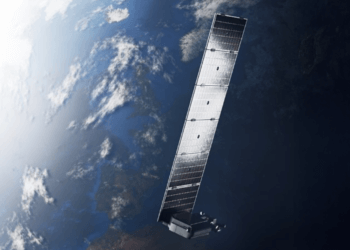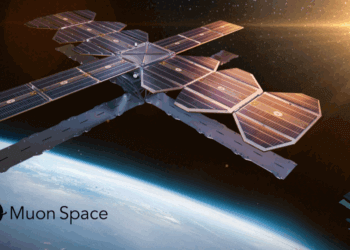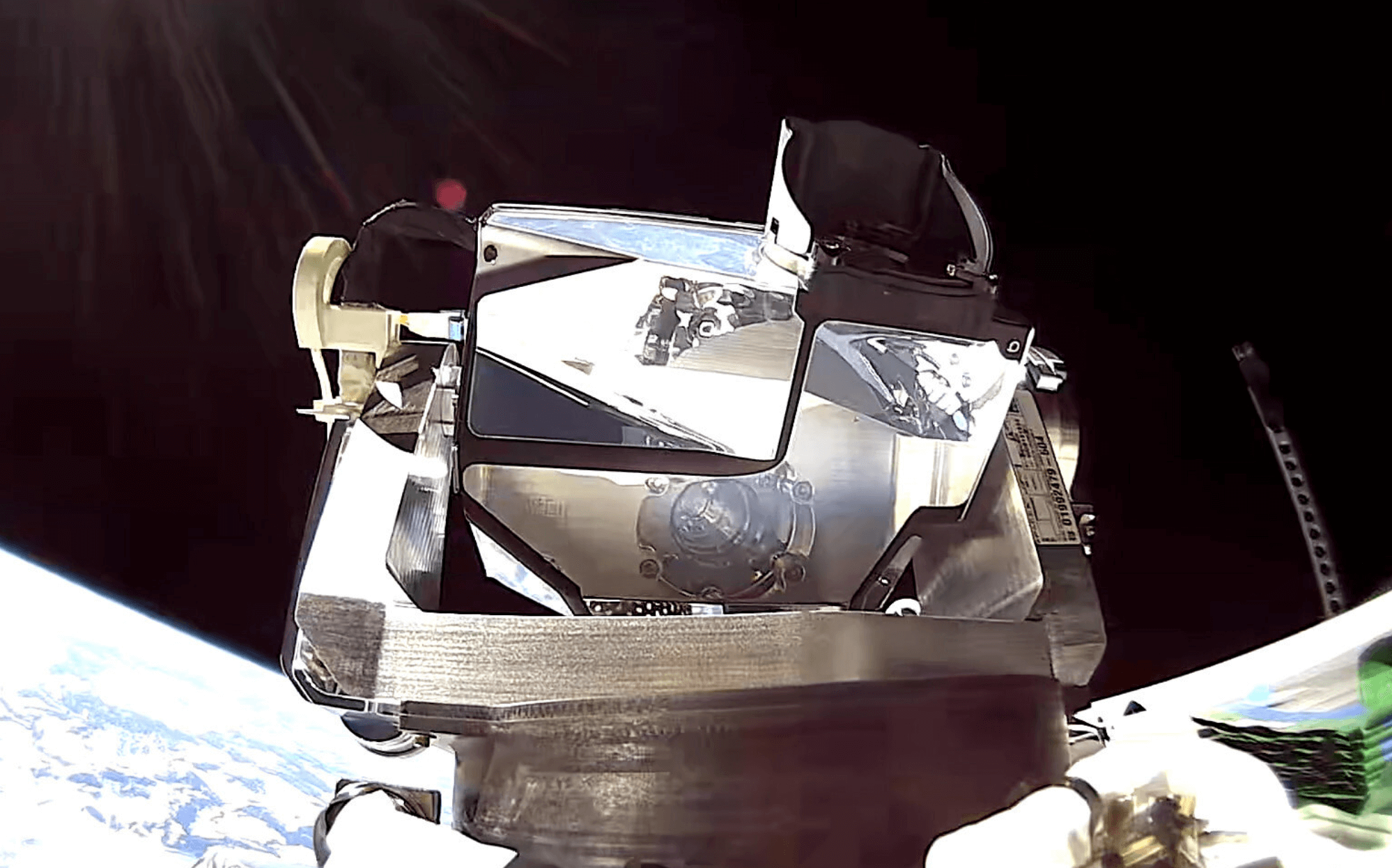
Muon Space signed an agreement with SpaceX’s Starlink to integrate Starlink’s “mini laser” terminals into Muon’s Halo™ satellite platform, establishing the first persistent optical broadband network for commercial satellites. The collaboration enables real-time, high-bandwidth connectivity between Muon’s spacecraft and Starlink’s global laser-linked constellation, reducing latency to milliseconds and transforming satellite operations from intermittent to continuous communications.
Starlink’s mini laser terminals deliver 25 Gbps links across distances up to 4,000 km, with higher rates at shorter ranges. The integration allows Muon’s satellites to maintain near-constant data streams through Starlink’s in-orbit optical mesh to terrestrial Points of Presence, supporting real-time tasking, command-and-control, and edge-AI workloads. This new model positions Muon’s Halo satellites as active nodes in a global digital infrastructure, capable of continuous, secure data exchange comparable to terrestrial cloud and telecom networks.
Muon will debut its first Starlink-enabled Halo satellite in Q1 2027. One early application, the Earth Fire Alliance’s FireSat constellation, will use Starlink’s optical network to reduce wildfire alert latency from 20 minutes to near-real-time. Muon says the persistent connectivity will redefine space operations by turning satellites into extensions of Earth’s data centers and enabling new classes of time-critical missions.
• Starlink mini laser terminals deliver 25 Gbps optical links over 4,000 km
• Muon Halo satellites become always-on network nodes in Starlink’s in-space mesh
• Millisecond-level latency from orbit to ground enables real-time tasking and AI processing
• FireSat constellation will gain near-instant wildfire detection and data delivery
• First launch of Starlink-enabled Halo satellite scheduled for Q1 2027
“This is a sea change in how space systems operate,” said Pascal Stang, CTO of Muon Space. “With persistent optical broadband, Muon Halo satellites will move from being isolated vehicles to becoming active, real-time nodes on Starlink’s global network.”
🌐 Analysis:
This partnership marks a pivotal milestone in the convergence of satellite networking and terrestrial broadband architecture. By fusing Muon’s mission-optimized satellites with Starlink’s laser mesh, commercial space operators gain cloud-like, low-latency data exchange previously unavailable in LEO constellations. The move follows growing momentum for optical inter-satellite links (OISLs) among players like Amazon Kuiper and OneWeb, underscoring a race toward globally persistent space-to-cloud integration.
Muon Space is a Silicon-Valley aerospace startup headquartered in Mountain View, California (2250 Charleston Rd, 94043) . The company’s mission is to design, build and operate high-volume small-satellite constellations to deliver “Earth intelligence” – that is, remote-sensing data and analytics for climate, natural-resource, commercial and defense use cases.
At its core, Muon Space is developing its proprietary “Muon Halo™” end-to-end platform: an integrated hardware-software stack that spans spacecraft design, manufacturing, launch, operations and data processing — enabling customers to deploy their own tailored constellation much more quickly and cost-effectively than traditional aerospace models.
The company was founded in 2021 by a team of veterans including Jonny Dyer (CEO) and co-founders Paul Day, Dan McCleese, Reuben Rohrschneider and Pascal Stang — who collectively brought decades of experience at organizations such as SpaceX, Skybox Imaging and NASA into the venture. Regarding funding and ownership, Muon Space recently closed a Series B funding round totalling approximately US$146 million (including ~$44.5 m equity and ~$45 m in credit facilities) in 2025, bringing the company into a scale-up phase. Investors include Activate Capital, Costanoa Ventures, Radical Ventures, Congruent Ventures and others from earlier rounds.