Converge! Digest: Every study points to an aggressive growth in mobile video traffic over the next few years. How will the network evolve to address this challenge?
Manish Singh: Yes, if you look at the fastest growing segment of the mobile networks, it is video.

One of the challenges operators face is that traffic is not necessarily monetizable. So what Radisys is doing is really enabling operators to take all of this video and find ways to increase ARPU.
We’re trying to bring new services to market that will enable operators to start monetizing video, especially real-time video. For example, video conferencing is a great solution that operators can offer as a premium service to enterprises. Other examples are video ringback tones or video mail — these are interesting services that can be customized by the consumer and have great appeal, at least in certain geographies, while being monetizable.
Think of advanced business services. Today you may call an airline and reach their interactive voice response system. We believe that tomorrow, with all the smartphones and network infrastructure in place, the airline should be able to provide an interactive voice and interactive video response system that correctly communicates with the consumer. So services like these, where video truly enables a better real-time communications experience, are going to be hot.
I believe there is a lot of potential for operators to monetize this traffic, drive ARPU up, and deliver a better experience to the consumer.
Converge! Digest: One of the big challenges that operators face is how to scale their networks for millions or even tens of million of LTE users. What technologies do you see having a big impact here?
Manish Singh: When it comes to network scalability, different dimensions come into play.
In the control plane layer, for example, workloads like MMEs or HLRs or PCRF, lend themselves very well for virtualization as well as scalability through cloud computing architectures.
So what we need is the right platform for virtualized payloads to scale up. These could also provide workload consolidation to free up resources for other applications.
Converge! Digest: How do you expect the core network of mobile operators to evolve over the next 5 years?
 Manish Singh: Looking 5 years out, what I see is that a lot of the control plane infrastructure and a lot of the service plane infrastructure in the operator’s core and IMS is going to get virtualized and will really be enabled by cloud-like technologies.
The underlying platforms need to be telecom-grade so that the operators are not making any tradeoffs of five-nines versus cloud. This means bringing a five-nine’s carrier-grade cloud platform.
In the data plane layer I also see a lot of gateways and policy enforcement platforms will have edge routing capacities built in. A lot of load balacing capabilities will also be brought into these gateways and they will be further enabled by SDN. So that’s what I see five years ahead.
Converge! Digest: A lot of people say software is the future of networking. What does it take to be a key player in this area?
 Manish Singh: The future of networking is definitely going to be enabled by software but at the same time carriers will still need the underlying hardware to make it functional and secure.
From a Radisys perspective, to really get to software enabled networks, we known that we must supply hardware solutions for edge routing, load balancing, compact gateways, etc. We also must deliver the software required for an integrated solution while enabling our customers to be able to create a differentiated product.
Converge! Digest: Radisys has talked about an end-to-end vision for network evolution. How are the pieces of this solution coming together?
 Manish Singh: We do believe that operators need to maximize spectrum utilization in the RAN in order to effectively deal with the tsunami. To do that, small cells are essential.
We have developed a complete software solution for small cells. We did that for 3G and are doing so again for LTE small cell solutions. In fact, we recently announced the world’s first small cell deployment at scale by network operator in South Korea. This was enabled by our software and we are very pleased with the progress here. Our partners now have over 30 active small cell trials underway with major operators around the world. In addition, we are moving the ball ahead with small cell solutions for LTE-Advanced — we’ve had a world-first demonstration at Mobile World Congress in Barcelona showing LTE-Advanced with carrier aggregation in a small cell.
So that’s what we are doing in the RAN. Further down in the packet core, we have an undisputed leadership position with our ATCA platforms. These are enabling a wide range of network functions in both the control plane and the data plane. We’ve added deep packet inspection (DPI) capabilities in these platforms to deliver policy enforcement capabilities.
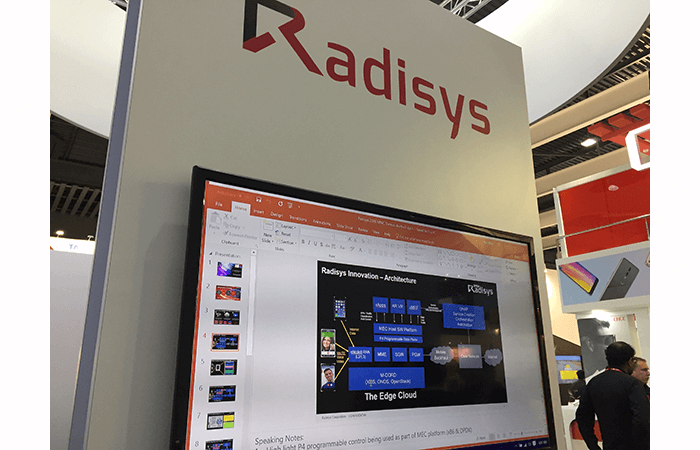
As we look forward, we see a lot of interest building up in network virtualization and software defined networking (SDN) technologies. Given our strong track record in the telecommunications field, Radisys is going to bring the right solutions forward for network virtualization functions at the control layer as well as SDN capabilities in the data plane.
Moving further on into the network’s IMS domain, we also believe that wnetwork operators need to focus on traffic monetization capabilities that increase ARPU. With our IMS media resource function, we are enabling operators to start monetizing voice over LTE (VoLTE). As a proof point, Radisys enabled the world’s first VoLTE commercial rollout at MetroPCS. This will be followed with a range of premium services, such as video conferencing, video mail, video ring back tones, interactive voice and video response system for better customer support… so a whole range of opportunites for mobile operators to monetize new traffic.
Converge! Digest: LTE rollouts are now underway by at least 145 operators worldwide, but already we see the next wave of LTE-Advanced moving through the standards committees. Is this next wave of standards upgrades any different from what we’ve seen before?

Manish Singh: We know that standards are always a moving target for equipment vendors and network operators. There are many waves of technologies that come in to enable these new services or to bring new efficiencies to the infrastructure. For example, we are now seeing a lot of development in LTE-Advanced going on in the 3GPP working groups. We are constantly releasing updates to keep pace. Capabilities such as carrier aggregation are becoming very important for LTE-Advanced, so we are bringing this to market. Another hot area of interest is ETSI’s work in network function virtualization. Radisy is actively working on that with operators and equipment ecosystem partners to really help shape how the power of the cloud and SDN can deliver a more optimized network. This could significantly improve network efficiency.
With our 25-year track record of innovating in the telecom space, Radisys is well positioned to drive this next wave forward.
About Radisys

Radisys (NASDAQ: RSYS) is a market leader enabling wireless infrastructure solutions for telecom, aerospace and defense applications. Radisys’ market-leading ATCA, MRF (Media Resource Function)and COM Express platforms coupled with world-renowned Trillium software, services and market expertise enable customers to bring high-value products and services to market faster with lower investment and risk. Radisys solutions are used in a wide variety of 3G & 4G / LTE mobile network applications including: Radio Access Networks (RAN) solutions from femtocells to picocells and macrocells, wireless core network applications, Deep Packet Inspection (DPI) and policy management; conferencing and media services including voice, video and data, as well as customized mobile network applications that support the aerospace and defense markets.
About Manish Singh
Manish joined Radisys in 2011 with the acquisition of Continuous Computing. Prior to Radisys, Manish was the Vice President of Product Line Management at Continuous Computing. Before Continuous Computing, Manish held various engineering management and architect positions at Intel Corporation, Trillium Digital Systems, and C-DOT (Center for Development of Telematics). Manish has an M.S. degree in computer science from India Institute of Science, Bangalore and a B.S. degree in electronics and telecommunication from Shri G.S. Institute of Technology & Science, Indore and sits on the Femto Forum board of directors.