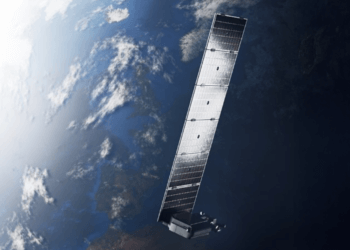
EchoStar agreed to sell its entire portfolio of AWS-4 and H-block spectrum licenses to SpaceX in a deal valued at approximately $17 billion. The transaction includes up to $8.5 billion in cash and an equivalent amount in SpaceX stock, along with SpaceX assuming responsibility for about $2 billion in EchoStar debt interest payments through November 2027. The agreement paves the way for SpaceX to deploy an upgraded Starlink Direct-to-Cell satellite constellation using this exclusive mid-band spectrum.
The two companies also announced a long-term commercial partnership under which EchoStar’s Boost Mobile subscribers, through its cloud-native 5G core, will gain access to Starlink’s Direct-to-Cell service. EchoStar said proceeds from the sale will be used to retire debt and fund continued operations across its DISH TV, Sling, and Hughes businesses, which will remain unaffected by the transaction. The companies expect to close the deal following regulatory approvals, likely resolving pending FCC inquiries regarding EchoStar’s spectrum holdings.
Hamid Akhavan, EchoStar’s president and CEO, said the transaction “allows for the combination of AWS-4 and H-block spectrum from EchoStar with the rocket launch and satellite capabilities from SpaceX to realize the direct-to-cell vision in a more innovative, economical and faster way for consumers worldwide.”
Key details
• EchoStar to sell AWS-4 and H-block spectrum licenses to SpaceX for about $17 billion
• Transaction includes up to $8.5 billion cash and $8.5 billion in SpaceX stock
• SpaceX to fund $2 billion of EchoStar debt interest payments through 2027
• New long-term commercial agreement integrates Starlink Direct-to-Cell with Boost Mobile
• Deal expected to resolve ongoing FCC inquiries into EchoStar’s spectrum holdings
Gwynne Shotwell, president and COO of SpaceX, said, “This transaction will advance our mission to end mobile dead zones around the world. With exclusive spectrum, SpaceX will develop next-generation Starlink Direct-to-Cell satellites that deliver a step change in performance.”
| Band | Frequency range (U.S.) | Primary use for Starlink/SpaceX | FCC authorization / license family | Status / notes (United States) |
|---|---|---|---|---|
| Ku / Ka (NGSO FSS – Gen1 & Gen2 Starlink) | Downlink: 10.7–12.7 GHz; 17.7–18.6 GHz; 18.8–20.2 GHz Uplink: 12.75–13.25 GHz; 13.85–14.5 GHz; 27.5–30.0 GHz | Core broadband access for Starlink user terminals and gateways (Gen1 and Gen2 constellation). | Gen1 Starlink NGSO FSS authorization (Call Sign S2983, SAT-LOA-20161115-00118 and mods); Gen2 Starlink NGSO FSS authorization (Call Sign S3069, SAT-LOA-20200526-00055 and mods). | Active, nationwide satellite service with blanket U.S. earth-station permissions for consumer and enterprise Starlink. |
| V-band (NGSO FSS – V-band Starlink) | Downlink: 37.5–42.0 GHz Uplink: 47.2–50.2 GHz (with narrower sub-bands under later Gen2/V-band modifications) | Future very-high-capacity NGSO FSS links for Starlink (backhaul and potentially user links) in V-band spectrum. | V-band NGSO FSS authorization (SAT-LOA-20170301-00027 – “V-band Starlink”), plus Gen2/V-band modification filings. | Authorized; Starlink has regulatory clearance but has not widely deployed commercial V-band user service yet in the U.S. |
| E-band gateways (NGSO backhaul) | Downlink: 71–76 GHz Uplink: 81–86 GHz | High-throughput gateway backhaul between U.S. ground stations and Gen2 Starlink satellites. | Gateway earth-station licenses and Special Temporary Authorities (e.g., E-band gateways such as E240080 in Boca Chica, TX) tied to the Gen2 Starlink system (Call Sign S3069). | Active in the U.S. under a mix of permanent authorizations and recurring STAs for multiple E-band gateway sites. |
| Direct-to-cell (SCS on PCS 1900 MHz – T-Mobile partnership) | Uplink (device-to-satellite): 1910–1915 MHz segment of the PCS band Downlink (satellite-to-device): 1990–1995 MHz segment of the PCS band | Starlink Direct-to-Cell supplemental coverage from space (SCS), using T-Mobile’s flexible-use PCS spectrum to talk directly to LTE handsets. | Starlink/T-Mobile SCS authorization (GN Docket 23-135; SAT-MOD-20230207-00021 and related waivers, including DA 25-197 on higher PFD limits). | Active: FCC has granted Starlink authority to operate SCS on these PCS segments. The underlying PCS licenses remain with T-Mobile; Starlink holds the satellite operating authority, not the terrestrial spectrum licenses themselves. |
| AWS-4 (2 GHz) – EchoStar spectrum being sold to SpaceX | Uplink: 2000–2020 MHz Downlink: 2180–2200 MHz | Planned use for Starlink’s next-generation Direct-To-Cell constellation and/or hybrid MSS/5G services, once transfer completes. | AWS-4 flexible-use licenses (currently AWS-4 mobile-satellite/flexible-use spectrum assigned to EchoStar under Part 27). | Not yet held by SpaceX/Starlink: EchoStar and SpaceX signed a definitive agreement (approx. $17B) for these licenses; transfer is subject to FCC and other regulatory approvals and closing conditions. |
| PCS H-block – EchoStar spectrum being sold to SpaceX | Uplink: 1915–1920 MHz Downlink: 1995–2000 MHz | Potential extension band for satellite-to-phone and/or integrated terrestrial 5G services aligned with Starlink Direct-To-Cell strategy. | PCS H-block Advanced Wireless Services licenses (Part 27 flexible-use spectrum currently licensed to EchoStar). | Not yet held by SpaceX/Starlink: included in the same definitive agreement with EchoStar as AWS-4; closing will determine when Starlink can actually operate on this spectrum. |
| Other satellite support / experimental bands | Various (including launch vehicle telemetry bands, test ranges, and ad-hoc earth-station test channels). | Launch telemetry, payload testing, experimental gateway and user-terminal trials, and other non-routine operations. | Numerous Experimental Radio Service (ERS) and STA grants to Space Exploration Technologies Corp., Starlink Services, Inc., and SpaceX Services, Inc. | Short-term, rotating authorizations; too many and too transient to list individually here. These do not usually confer long-term, exclusive spectrum rights. |
🌐 Analysis: This deal unites EchoStar’s terrestrial spectrum assets with SpaceX’s orbital infrastructure, creating a powerful platform for global hybrid satellite-cellular connectivity. It positions SpaceX to accelerate Starlink’s Direct-to-Cell rollout, competing with AST SpaceMobile, Lynk Global, and other LEO satellite-to-handset initiatives. For EchoStar, the $17 billion windfall strengthens its balance sheet and may ease regulatory pressures following its merger with DISH Network, while reaffirming its focus on fixed and broadcast connectivity through Hughes and DISH.
In August 2025 EchoStar struck a ≈ US$23 billion agreement to sell certain wireless spectrum licenses to AT&T Inc.. Under this deal AT&T agreed to acquire approximately 30 MHz of nationwide mid-band spectrum (in the 3.45 GHz band) and about 20 MHz of low-band spectrum (in the 600 MHz band) from EchoStar. EchoStar also amended its long-term wholesale/operational agreement with AT&T to enable EchoStar (via its Boost Mobile brand) to access AT&T’s network infrastructure as part of the hybrid model.
With this sale to AT&T, EchoStar moved away from being a full-scale facilities-based wireless provider building its own nationwide terrestrial network, and instead shifted toward a model where it monetizes spectrum assets and uses network wholesale relationships. Industry commentary pointed out that this deal effectively ended EchoStar’s bid to become the “fourth major U.S. wireless carrier”
🌐 We’re tracking the latest developments in satellite-to-cell and hybrid space-terrestrial networks. Follow our ongoing coverage at: https://convergedigest.com/category/space