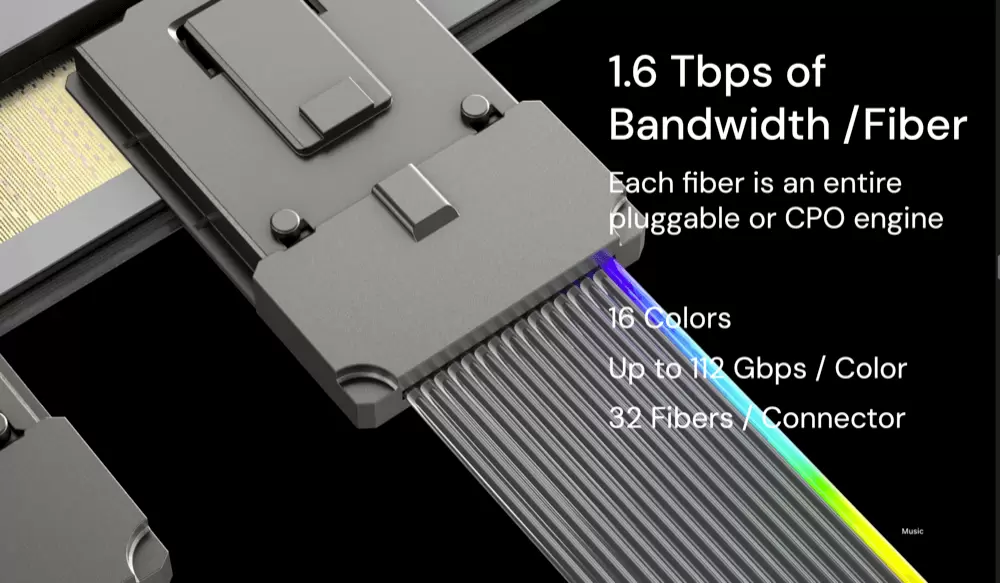
Lightmatter introduced a 16-wavelength (λ) bidirectional Dense Wavelength Division Multiplexing (DWDM) link that operates on a single strand of standard single-mode fiber, setting a new benchmark for data center interconnects. The company’s Passage photonics engine and Guide laser technology enable 800 Gbps of bidirectional bandwidth per fiber (400 Gbps transmit and 400 Gbps receive) across distances of up to 1 km. This marks an 8X leap in bidirectional wavelengths per fiber compared to previous solutions, which were limited to two wavelengths.
The design interleaves odd and even wavelengths across the 1310 nm band, with eight odd channels transmitting in one direction and eight even channels transmitting in the opposite. Each channel operates at 50 Gbps, with 200 GHz spacing between adjacent transmit/receive channels and 400 GHz spacing between channels traveling in the same direction. Lightmatter integrates ultra-efficient micro-ring modulators (MRMs), photodetectors, and analog circuitry onto a single monolithic silicon photonics die, using closed-loop digital stabilization to manage thermal drift. The system is polarization-insensitive, enabling use of cost-effective SMF rather than polarization-maintaining fiber.
By doubling radix—the number of I/O ports per switch or processor—the technology reduces network hops, lowers latency, cuts power consumption, and minimizes cost in large AI clusters. For trillion-parameter Mixture-of-Experts (MoE) models, higher radix interconnects keep expert communication within high-bandwidth domains, avoiding scale-out bottlenecks and enabling faster training times. Lightmatter positions this BiDi link as the natural evolution of co-packaged optics (CPO) toward next-generation AI supercomputers.
- 16λ bidirectional DWDM link on standard SMF
- 1310 nm band operation, 50 Gbps per channel
- 800 Gbps per fiber (400 Gbps Tx + 400 Gbps Rx)
- Distance: several hundred meters up to 1 km
- 200 GHz spacing (Tx/Rx), 400 GHz spacing (same direction)
- Polarization-insensitive, no need for PM fiber
- Monolithic integration: MRMs, drivers, TIAs, photodetectors
- Closed-loop digital thermal stabilization
- Doubling radix: higher port density, fewer hops, lower latency
“Data centers are the new unit of compute in the AI era, with the next 1000X performance gain coming largely from ultra-fast photonic interconnects,” said Nicholas Harris, founder and CEO of Lightmatter. “Our 16-lambda bidirectional link is an architectural leap forward.”


🌐 Analysis: Lightmatter’s 16-λ BiDi advance underscores a broader strategic shift: interconnect bandwidth and radix—not just chip performance—are becoming the defining limits of AI infrastructure. By packing more wavelengths into a single fiber and eliminating the need for dual-fiber links, Lightmatter addresses one of the most stubborn constraints in hyperscale system design: the physical and economic limits of fiber density. This positions photonic interconnects not just as a performance upgrade, but as a way to cut layers of switching, reduce power at scale, and simplify cabling in sprawling AI clusters.
For networking vendors, this approach raises competitive pressure on traditional pluggable optics and early CPO designs, which typically scale by adding more fibers. For hyperscalers, it opens a path to denser GPU-to-GPU connectivity without hitting rack-space or power ceilings. If widely adopted, this could ripple into the switch silicon ecosystem, as radix-doubling optics reduce demand for additional switch tiers and alter network topologies in favor of flatter, lower-latency fabrics. In short, Lightmatter is making the case that photonics isn’t just about moving data faster—it’s about restructuring the economics and architectures of the data center itself.
Company Backgrounder: Lightmatter
Founded in 2017, Lightmatter is based in Mountain View, California, with offices in Boston and Toronto. The company specializes in silicon photonics and 3D co-packaged optics designed for AI and high-performance computing interconnects. Its core technology, the Passage platform, integrates photonics directly with advanced packaging to eliminate I/O bottlenecks in large-scale compute clusters.
Lightmatter has raised approximately $850 million in venture funding. Its investor base includes Fidelity, Google Ventures, Sequoia Capital, Spark Capital, Viking Global, T. Rowe Price, Matrix Partners, SIP Capital, and university-linked funds from MIT and Stanford . The leadership team is led by co-founder and CEO Nicholas Harris, Ph.D., and co-founder and Chief Scientist Darius Bunandar, Ph.D., with Simona Jankowski serving as CFO.
The company’s roadmap includes:
- Passage L200 – A 3D co-packaged optics engine delivering up to 64 Tbps total bandwidth with 1.6 Tbps per fiber using 16 wavelengths.
- Passage M1000 – A 3D photonic “superchip” platform with 114 Tbps total bandwidth and up to 1 Pbps switch capacity when scaled to a million-node interconnect.
- Guide lasers – Co-developed photonic light sources supporting the Passage ecosystem.
Lightmatter’s mission is to make photonics foundational to AI-scale computing. Its strategy goes beyond bandwidth, aiming to reduce total cost of ownership (TCO) for hyperscale operators by cutting switch tiers, lowering energy per bit, and enabling flatter network architectures that accelerate model training efficiency.
🌐 We’re tracking the latest developments in networking silicon. Follow our ongoing coverage at: https://convergedigest.com/category/semiconductors/