• Home
  • Events Calendar
  • Blueprint Guidelines
  • Privacy Policy
  • Subscribe to Daily Newsletter
  • NextGenInfra.io
No Result
View All Result
Converge Digest
Tuesday, May 5, 2026
  • Home
  • Events Calendar
  • Blueprint Guidelines
  • Privacy Policy
  • Subscribe to Daily Newsletter
  • NextGenInfra.io
No Result
View All Result
Converge Digest
No Result
View All Result

Home » MIT-NASA Develop First Interplanetary Laser Communications

MIT-NASA Develop First Interplanetary Laser Communications

August 11, 2004
in Uncategorized
A A

A NASA–MIT Lincoln Laboratory team is undertaking a project to develop and the first deep-space, interplanetary laser communication link by 2010. The Mars Laser Communication Demonstration (MLCD), which will fly on the Mars Telecommunications Orbiter spacecraft, aims to test a laser-based communication link that would operate at a rate nearly ten times higher than any existing interplanetary radio communication. Today, the maximum data rate transmitted to Earth by spacecraft at Mars is about 128,000 bits per second (for NASA’s Mars Odyssey spacecraft). Depending on weather and atmospheric conditions on Earth, and the positions of the planets, the team expects to receive data at a rate of a million bits per second, and possible 30 times higher. The experiment is a partnership among NASA’s Goddard Space Flight Center, NASA’s Jet Propulsion Laboratory (JPL), and MIT’s Lincoln Laboratory (MIT/LL). http://web.mit.edu/newsoffice/2004/optical.html

Tags: AllOptical
ShareTweetShare
Previous Post

Cisco Ships its Millionth IP Phone in Europe

Next Post

Germany Opens Consultation on Local Loop Access

Staff

Staff

Related Posts

Microsoft Inks 5-Year, Multi-Billion Deal with KT to Drive AI in Korea
Optical

Open RAN xHaul and IPoDWDM Solutions Take Center Stage

February 27, 2025
Ribbon Communications Secures $385 million credit facility
Optical

Ribbon Completes DWDM Deployment for Bharti Airtel

October 27, 2024
Tech Update video: Ayar Labs’ Optical I/O Chiplets
Optical

ECOC24 video: What’s Next for Optical DSPs? 1.6T and Beyond

September 24, 2024
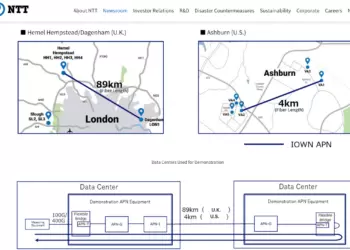
NTT Achieves Less Than 1ms Latency, Below 1μs Jitter at 400Gbps
Optical

NTT Achieves Less Than 1ms Latency, Below 1μs Jitter at 400Gbps

April 12, 2024
#OFC24: A New Class of Silicon Photonics for AI Data Centers
Video

Big Power Savings with 800G Linear Receive Optics

April 4, 2024
AFL acquires Optical Telecom for DAS expertise
Optical

Fujikura’s AFL to build fiber manufacturing factory in Poland

October 18, 2023
Next Post

FCC Takes Measures to Reform E-Rate Program

Please login to join discussion

Categories

  • 5G / 6G / Wi-Fi
  • AI Infrastructure
  • All
  • Automotive Networking
  • Blueprints
  • Clouds and Carriers
  • Data Centers
  • Enterprise
  • Explainer
  • Feature
  • Financials
  • Last Mile / Middle Mile
  • Legal / Regulatory
  • Optical
  • Quantum
  • Research
  • Security
  • Semiconductors
  • Space
  • Start-ups
  • Subsea
  • Sustainability
  • Video
  • Webinars

Archives

Tags

5G All AT&T Australia AWS Blueprint columns BroadbandWireless Broadcom China Ciena Cisco Data Centers Dell'Oro Ericsson FCC Financial Financials Huawei Infinera Intel Japan Juniper Last Mile Last Mille LTE Mergers and Acquisitions Mobile NFV Nokia Optical Packet Systems PacketVoice People Regulatory Satellite SDN Service Providers Silicon Silicon Valley StandardsWatch Storage TTP UK Verizon Wi-Fi
Converge Digest

A private dossier for networking and telecoms

Follow Us

  • Home
  • Events Calendar
  • Blueprint Guidelines
  • Privacy Policy
  • Subscribe to Daily Newsletter
  • NextGenInfra.io

© 2025 Converge Digest - A private dossier for networking and telecoms.

No Result
View All Result
  • Home
  • Events Calendar
  • Blueprint Guidelines
  • Privacy Policy
  • Subscribe to Daily Newsletter
  • NextGenInfra.io

© 2025 Converge Digest - A private dossier for networking and telecoms.

This website uses cookies. By continuing to use this website you are giving consent to cookies being used. Visit our Privacy and Cookie Policy.
Go to mobile version