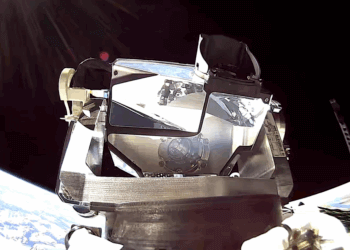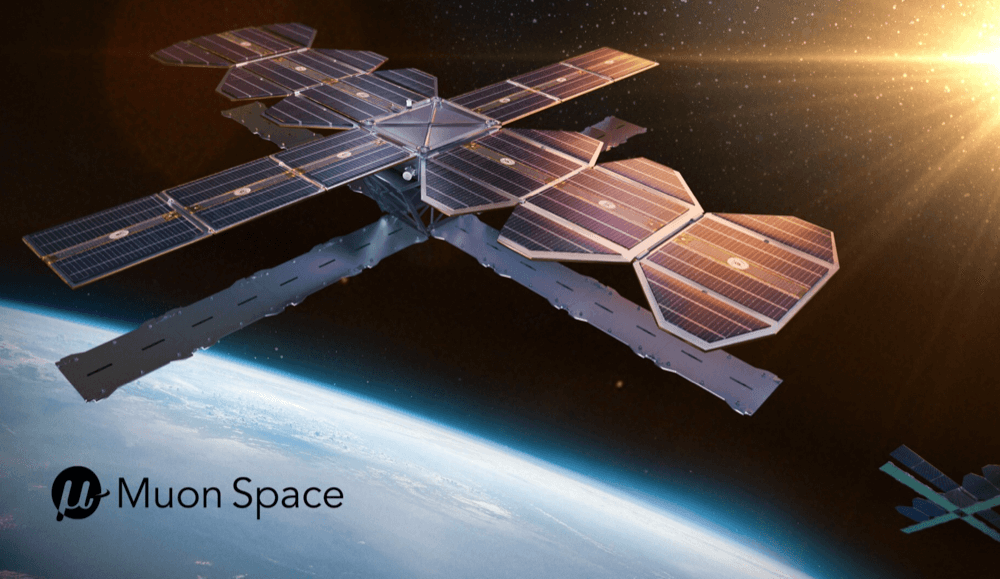
Muon Space has launched its most powerful satellite platform to date — the MuSat XL — marking a major advancement in its low Earth orbit (LEO) constellation capabilities. Weighing in at 500 kg, the MuSat XL supports multi-payload missions with increased power, bandwidth, and pointing accuracy. The inaugural customer is Hubble Network, which is building the first Bluetooth Low Energy (BLE) satellite network for global device connectivity.
The MuSat XL will host Hubble’s next-generation BLE payload featuring a phased-array antenna and a highly sensitive receiver that improves signal detection by 30x over previous CubeSat models. This enables direct BLE links from space to ultra-low-cost, low-power IoT devices. The first two MuSat XL satellites will offer 12-hour global revisit times, laying the foundation for a scalable BLE finding network targeting logistics, defense, infrastructure, and consumer use cases.
Muon’s platform delivers over 1 kW average orbit payload power, 5+ TB/day downlink capacity, and precise attitude control, making it suitable for advanced Earth observation, edge computing, and secure communications. Built on Muon’s proven Halo™ tech stack, MuSat XL emphasizes integration flexibility, real-time networking, and manufacturing scalability for commercial and national security customers.
“XL is more than a bigger bus – it’s a true enabler for customers pushing the boundaries of what’s possible in orbit, like Hubble,” said Jonny Dyer, CEO of Muon Space.
🌐 Why it Matters: The MuSat XL raises the bar for commercial satellite buses by integrating real-time compute, high-throughput comms, and flexible payload capacity into a manufacturable platform. For Hubble, this leap enables a Bluetooth layer from space — a novel architecture with wide-ranging implications for global IoT scalability.
Muon Space, headquartered in Mountain View, California, is a venture-backed space technology company specializing in the development and operation of advanced satellite constellations for Earth observation and climate monitoring. Founded in 2021 by former Google and NASA Ames executive Jonny Dyer (CEO), along with CTO Rob Zimmerman and CSO Paul Wercinski, the company’s mission is to enable a deeper understanding of Earth’s systems through vertically integrated space-based sensing solutions. Its proprietary satellite platforms, including the flight-proven Halo™ and newly introduced MuSat XL, are designed to deliver high-fidelity, mission-specific data across a range of applications—from national defense and disaster response to environmental monitoring and commercial analytics. Muon Space operates as both a satellite manufacturer and end-to-end mission provider, with in-house capabilities spanning spacecraft design, sensor integration, ground systems, and data delivery. Key milestones include the launch of its first satellite in June 2023 and a strategic partnership with Hubble Network in 2025 to support the world’s first satellite-powered Bluetooth network. The company has secured over $35 million in funding from prominent investors including Costanoa Ventures, Space Capital, and Congruent Ventures.
Hubble Network, based in Seattle, Washington, is building the world’s first satellite-powered Bluetooth Low Energy (BLE) network designed to enable global, ultra-low-power connectivity for billions of devices. Founded by Alex Haro (former co-founder of Life360) and Ben Wild, the company aims to revolutionize the Internet of Things (IoT) landscape by eliminating the need for terrestrial cell towers or gateway infrastructure. Hubble’s core innovation lies in its proprietary waveform and software stack that allows standard BLE chips—found in over 20 billion existing devices—to communicate directly with satellites in low Earth orbit. This approach dramatically reduces the cost and energy requirements of IoT connectivity, unlocking use cases in asset tracking, logistics, agriculture, environmental monitoring, and remote industrial systems.
🌐 We’re tracking ongoing developments in the Space category at ConvergeDigest.com.