• Home
  • Events Calendar
  • Blueprint Guidelines
  • Privacy Policy
  • Subscribe to Daily Newsletter
  • NextGenInfra.io
No Result
View All Result
Converge Digest
Thursday, April 16, 2026
  • Home
  • Events Calendar
  • Blueprint Guidelines
  • Privacy Policy
  • Subscribe to Daily Newsletter
  • NextGenInfra.io
No Result
View All Result
Converge Digest
No Result
View All Result

Home » NeoPhotonics intros Coherent Modulator and Receiver for 800G+ waves

NeoPhotonics intros Coherent Modulator and Receiver for 800G+ waves

February 26, 2019
in All
A A

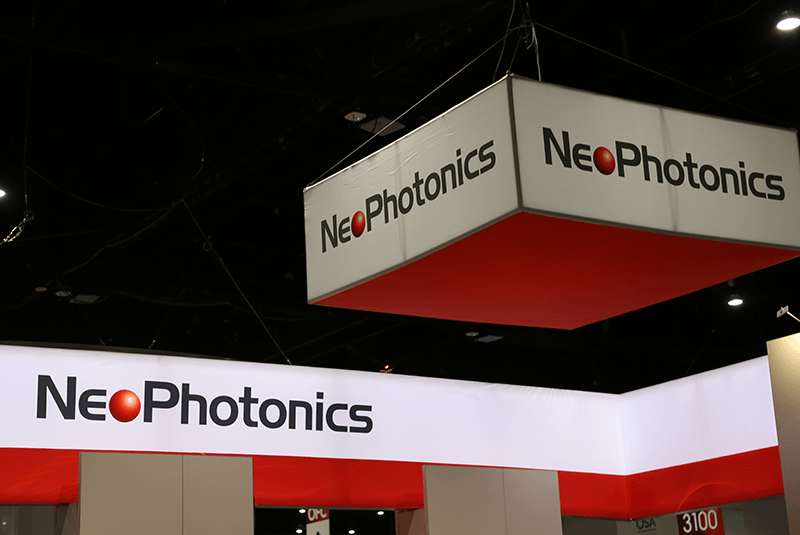
NeoPhotonics introduced Class 50 versions of its Micro-Modulator (CDM) and Coherent Receiver to its suite of High Bandwidth Coherent components. The new devices enable 800G+ wavelengths over data center interconnect (DCI) distances.

Class 50 Coherent components improve on the currently shipping Class 40 components, and allow increasing the symbol rate from the current 64 Gbaud rate to market leading 90-100 Gbaud rate.

NeoPhotonics said its new Class 50 components for 100 GBaud transmission are designed to work with the emerging new generation of coherent Digital Signal Processors based on the 7 nanometer Silicon process node and triple the symbol rate over standard 100Gbps (32 GBaud) coherent systems.   Higher symbol rates increase data capacity while maintaining superior optical single to noise ratio (OSNR), spectral density and reach performance.   All of these components are available in compact form factor packages suitable for use in pluggable modules and compact daughter cards.

  • Class 50 CDM:  NeoPhotonics Class 50, polarization multiplexed, quadrature coherent driver modulator (CDM) features a co-packaged InP modulator with a linear, high bandwidth, differential driver, and is designed for low V-Pi, low insertion loss and a high extinction ratio.   The compact package is designed to be compliant with the form factorof the OIF Implementation Agreement #OIF-HB-CDM-01.0.
  • Class 50 Micro-ICR:  NeoPhotonics Class 50 High Bandwidth Micro-Intradyne Coherent Receiver (Micro-ICR) is designed for 90-100 GBaud symbol rates, tripling the rate of standard 100G ICRs. The compact package is designed to be compliant with the OIF Implementation Agreement OIF-DPC-MRX-02.0.

In addition, NeoPhotonics has introduced a “Nano” ultra-narrow linewidth external cavity tunable laser, which cuts the size approximately in half compared to current Micro-ITLAs, while featuring industry leading linewidth with low electrical power consumption.

“We are currently providing our customers with a matched suite of high speed Class 40, 64 Gbaud, optical components to support current 600G per wavelength systems, and the addition of Class 50 versions will continue to support our customers as they move to 90-100 Gbaud and nearly 1 Terabit per wavelength,” said Tim Jenks, Chairman and CEO of NeoPhotonics.  “As new generations of electronics become available, it is crucial that the optical components are available to complete the suite, in this case realizing near 1 Terabit per second on a single wavelength,” continued Mr. Jenks.

https://www.neophotonics.com/

Tags: Blueprint columns
ShareTweetShare
Previous Post

Source Photonics opens new laser fab and assembly facility

Next Post

Intel launches FPGA-based accelerator for 5G core and vRAN

Staff

Staff

Related Posts

Blueprint: Brazil looks to municipal Wi-Fi 6E
Blueprints

Blueprint: Brazil looks to municipal Wi-Fi 6E

February 21, 2023
Blueprint: Building wholesale networks with OTN
All

Blueprint: Building wholesale networks with OTN

December 20, 2022
Oracle opens cloud region in Chicago
All

Oracle opens cloud region in Chicago

December 20, 2022
BT trials C-RAN in Leeds
All

BT trials C-RAN in Leeds

December 19, 2022
T-Mobile builds cloud native 5G converged core with Cisco
All

T-Mobile builds cloud native 5G converged core with Cisco

December 15, 2022
Meta halts data center expansion construction in Denmark
All

Meta halts data center expansion construction in Denmark

December 15, 2022
Next Post
Intel launches FPGA-based accelerator for 5G core and vRAN

Intel launches FPGA-based accelerator for 5G core and vRAN

Please login to join discussion

Categories

  • 5G / 6G / Wi-Fi
  • AI Infrastructure
  • All
  • Automotive Networking
  • Blueprints
  • Clouds and Carriers
  • Data Centers
  • Enterprise
  • Explainer
  • Feature
  • Financials
  • Last Mile / Middle Mile
  • Legal / Regulatory
  • Optical
  • Quantum
  • Research
  • Security
  • Semiconductors
  • Space
  • Start-ups
  • Subsea
  • Sustainability
  • Video
  • Webinars

Archives

Tags

5G All AT&T Australia AWS Blueprint columns BroadbandWireless Broadcom China Ciena Cisco Data Centers Dell'Oro Ericsson FCC Financial Financials Huawei Infinera Intel Japan Juniper Last Mile Last Mille LTE Mergers and Acquisitions Mobile NFV Nokia Optical Packet Systems PacketVoice People Regulatory Satellite SDN Service Providers Silicon Silicon Valley StandardsWatch Storage TTP UK Verizon Wi-Fi
Converge Digest

A private dossier for networking and telecoms

Follow Us

  • Home
  • Events Calendar
  • Blueprint Guidelines
  • Privacy Policy
  • Subscribe to Daily Newsletter
  • NextGenInfra.io

© 2025 Converge Digest - A private dossier for networking and telecoms.

No Result
View All Result
  • Home
  • Events Calendar
  • Blueprint Guidelines
  • Privacy Policy
  • Subscribe to Daily Newsletter
  • NextGenInfra.io

© 2025 Converge Digest - A private dossier for networking and telecoms.

This website uses cookies. By continuing to use this website you are giving consent to cookies being used. Visit our Privacy and Cookie Policy.
Go to mobile version