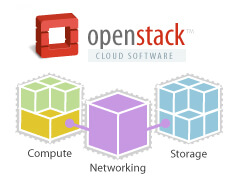

A new version of OpenStack released on Thursday adds important Networking (Quantum) and Block Storage (Cinder) services, along with many other enhancements.
The OpenStack “Folsom” release, which was built by more than 330 contributors, automates pools of compute, storage and networking resources, now including emerging Software Defined Networking (SDN) solutions via OpenStack Networking plug-ins, to build private and public cloud infrastructures without vendor lock-in.
OpenStack Networking currently includes plug-in support for Open vSwitch, the Ryu open source network operating system, standard Linux bridge networking and commercial solutions from Cisco, Nicira, and NEC, with others in development.
HP and Rackspace, which each operate large OpenStack public clouds, are putting Folsom into production
The OpenStack Foundation highlighted the following capabilities in the latest release.
OpenStack Compute (code-name Nova) – makes it easier for operators to configure large pools of virtual machines. A new “config drive” capability stores network configuration information, eliminating the need for DHCP, and a new “host aggregation” feature places workloads into the best pools of resources for the job, such as GPU clusters for HPC work. Performance and security enhancements enable users to expose unique features of the CPUs powering their cloud, including support for Trusted Computing, which relies on hardware to verify the cloud computing environment’s state. A cross-company Hyper-V team has been formed to reintroduce and improve support for the hypervisor.
OpenStack Object Storage (code-name Swift) – operators can now connect OpenStack Object Storage to a statsd server and receive hundreds of real-time metrics about their cluster to help with troubleshooting, diagnostics, day-to-day operational issues, and long-term capacity management. To improve performance, clusters with high write requirements or large quantities of stored objects can now take advantage of solid-state drives (SSDs) for storing metadata without incurring a high overhead in disk space. Additionally, the ability to place data in cluster locations that are “as unique as possible,” makes it easier to deploy small clusters and provides better flexibility for all clusters when handling hardware failure.
OpenStack Block Storage (code-name Cinder) – the first full release of OpenStack Block Storage implements advanced, extensible block and volume storage capabilities, while still supporting previously deployed OpenStack Volumes. Previously a sub-component of OpenStack Compute, the Block Storage capabilities of OpenStack have been promoted to a full project with a dedicated development team that will increase the rate of innovation as the OpenStack development community grows.
OpenStack Networking (code-name Quantum) – includes support for Open vSwitch, the Ryu open source network operating system, standard Linux bridge networking and commercial solutions from Cisco, Nicira, and NEC via a plug-in architecture. Additionally, the release includes significant updates to control Layer 2 networking, IP address management, API quotas, notifications, extension support for Layer 3 forwarding, Secure Network Address Translation (SNAT), and floating IPs. An integrated API policy framework allows network control at the tenant level or the admin-only level to be defined using the OpenStack Identity service, depending on an Enterprise or Service Provider’s requirements.
OpenStack Dashboard (code-name Horizon) -brings usability improvements in launching Compute instances, working Object Storage resources, and managing OpenStack projects and users. Other feature advances include support for public and private image uploads and management of advanced networks. End users will appreciate better cross-browser support, timezone support, dynamic quota displays, improved error handling, and performance improvements.
OpenStack Identity (code-name Keystone) – brings improved support for Public Key Infrastructure (PKI) authentication and improved integration and management across OpenStack services.
OpenStack Image Service (code-name Glance) – major advancements in usability and functionality to the Image Service, including a new API, a new client library, new replication options for increased performance and security improvements reaching from the client to the image storage system