• Home
  • Events Calendar
  • Blueprint Guidelines
  • Privacy Policy
  • Subscribe to Daily Newsletter
  • NextGenInfra.io
No Result
View All Result
Converge Digest
Saturday, April 18, 2026
  • Home
  • Events Calendar
  • Blueprint Guidelines
  • Privacy Policy
  • Subscribe to Daily Newsletter
  • NextGenInfra.io
No Result
View All Result
Converge Digest
No Result
View All Result

Home » Starlink Completes Initial Direct-to-Cell Satellite Network for Global Mobile Coverage

Starlink Completes Initial Direct-to-Cell Satellite Network for Global Mobile Coverage

December 5, 2024
in Space
A A

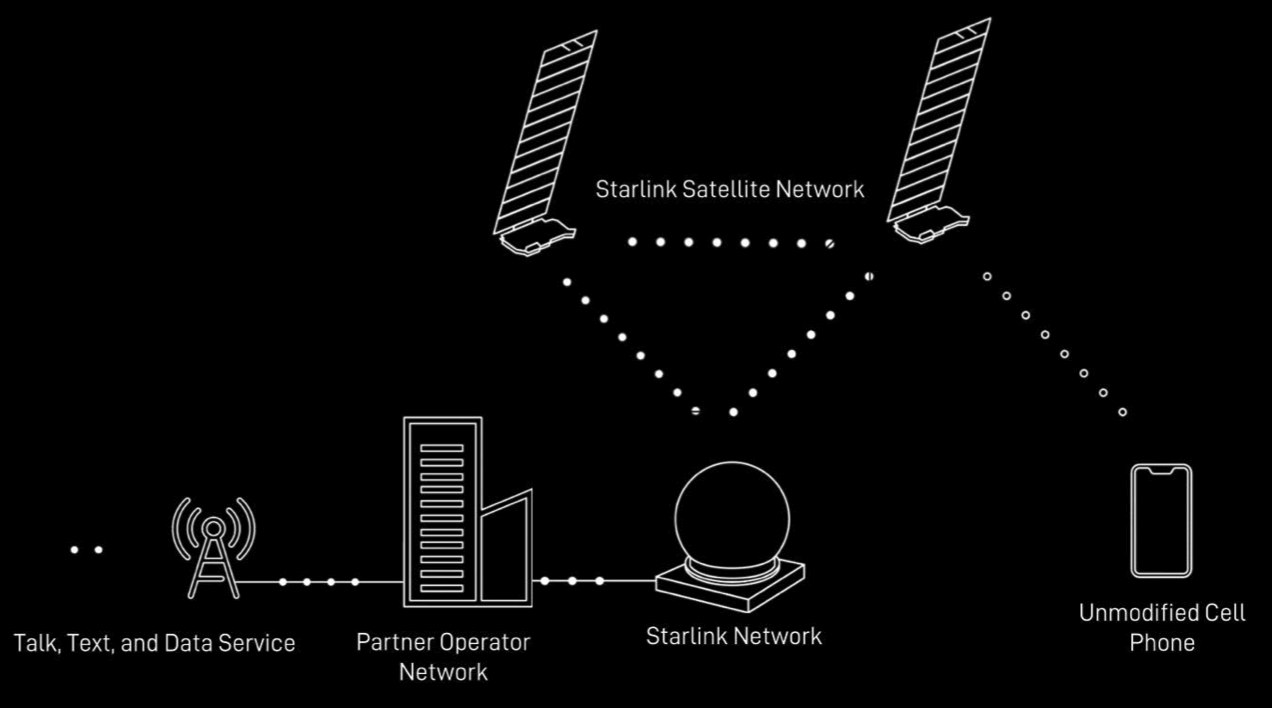
Starlink has completed its initial Direct-to-Cell (DTC) satellite constellation, enabling direct communication between standard LTE-compatible mobile phones and low Earth orbit satellites. This milestone was achieved with the recent launch of 20 additional satellites, bringing the total to over 320. The system is designed to support text messaging services, with plans to expand to voice and data capabilities by 2025. Operating at a 53-degree inclination, the satellites will be raised to an operational altitude of 360 km. The network aims to provide peak speeds of approximately 10 Mbps per beam, with future enhancements planned. 

Starlink’s DTC service has established partnerships with several international carriers to extend its global reach. Collaborations include T-Mobile in the United States, Rogers in Canada, One NZ in New Zealand, KDDI in Japan, Optus in Australia, Entel in Chile and Peru, and Salt in Switzerland. These alliances aim to eliminate mobile dead zones by providing text messaging capabilities, with plans to introduce voice and data services in 2025. This initiative allows carriers to offer seamless connectivity in areas previously beyond the reach of traditional cellular networks, leveraging Starlink’s satellite infrastructure for comprehensive global coverage.

Key Points:

• Constellation Completion: Over 320 satellites now support Starlink’s Direct-to-Cell service, with the latest launch adding 20 satellites to the network. 

• Operational Details: Satellites operate at a 53-degree inclination and will be raised to 360 km for full functionality. The system is engineered to provide approximately 10 Mbps per beam, with future upgrades planned. 

• Carrier Partnerships: Collaborations include T-Mobile (U.S.), Rogers (Canada), One NZ (New Zealand), KDDI (Japan), Optus (Australia), Entel (Chile and Peru), and Salt (Switzerland). 

• Service Timeline: Initial text messaging services are planned, with voice and data capabilities expected to roll out in 2025. 

• Global Coverage: The initiative aims to eliminate mobile dead zones, providing connectivity in previously unreachable areas through Starlink’s satellite infrastructure.

Tags: SpaceXStarlink
ShareTweetShare
Previous Post

Ericsson Launches Compact Packet Core 

Next Post

HPE Posts Strong Quarter, up 15% YoY

Jim Carroll

Jim Carroll

Editor and Publisher, Converge! Network Digest, Optical Networks Daily - Covering the full stack of network convergence from Silicon Valley

Related Posts

MetTel Extends SD-WAN Services Globally as Starlink Reseller
Space

Vodacom Taps Starlink Across Africa

November 14, 2025
SpaceX launches 48 more Starlink satellites
Space

EchoStar to Sell $17 Billion Spectrum Portfolio to SpaceX fo

November 6, 2025
MetTel Extends SD-WAN Services Globally as Starlink Reseller
Space

BT Signs with Starlink to Deliver Satellite Broadband Across the UK

November 6, 2025
Muon Space to Integrate SpaceX’s Starlink Mini Space Lasers
Space

Muon Space to Integrate SpaceX’s Starlink Mini Space Lasers

October 21, 2025
MetTel Extends SD-WAN Services Globally as Starlink Reseller
5G / 6G / Wi-Fi

SpaceX Gains 50 MHz S-band, Paving Way for Satellite-Grade 5G

September 8, 2025
Starship’s PEZ Dispenser Unlocks Starlink’s Multi-Tbps Future
Space

Starship’s PEZ Dispenser Unlocks Starlink’s Multi-Tbps Future

August 27, 2025
Next Post
HPE sees strength with Intelligent Edge and HPC solutions

HPE Posts Strong Quarter, up 15% YoY

Categories

  • 5G / 6G / Wi-Fi
  • AI Infrastructure
  • All
  • Automotive Networking
  • Blueprints
  • Clouds and Carriers
  • Data Centers
  • Enterprise
  • Explainer
  • Feature
  • Financials
  • Last Mile / Middle Mile
  • Legal / Regulatory
  • Optical
  • Quantum
  • Research
  • Security
  • Semiconductors
  • Space
  • Start-ups
  • Subsea
  • Sustainability
  • Video
  • Webinars

Archives

Tags

5G All AT&T Australia AWS Blueprint columns BroadbandWireless Broadcom China Ciena Cisco Data Centers Dell'Oro Ericsson FCC Financial Financials Huawei Infinera Intel Japan Juniper Last Mile Last Mille LTE Mergers and Acquisitions Mobile NFV Nokia Optical Packet Systems PacketVoice People Regulatory Satellite SDN Service Providers Silicon Silicon Valley StandardsWatch Storage TTP UK Verizon Wi-Fi
Converge Digest

A private dossier for networking and telecoms

Follow Us

  • Home
  • Events Calendar
  • Blueprint Guidelines
  • Privacy Policy
  • Subscribe to Daily Newsletter
  • NextGenInfra.io

© 2025 Converge Digest - A private dossier for networking and telecoms.

No Result
View All Result
  • Home
  • Events Calendar
  • Blueprint Guidelines
  • Privacy Policy
  • Subscribe to Daily Newsletter
  • NextGenInfra.io

© 2025 Converge Digest - A private dossier for networking and telecoms.

This website uses cookies. By continuing to use this website you are giving consent to cookies being used. Visit our Privacy and Cookie Policy.
Go to mobile version