Starlink, SpaceX’s ambitious satellite internet service, achieved key milestones in 2024 while unveiling its next-generation V3 satellites. With service now available in 118 countries and regions—encompassing a population of 2.8 billion—Starlink is bridging the digital divide by connecting 4.6 million active customers worldwide. In 2024, Starlink exceeded 300 Tbps of total capacity in its constellation.
Starlink is now previewing its V3 satellites, designed for deployment aboard SpaceX’s fully reusable Starship rocket, and representing a leap forward in capacity and performance.
V3 Satellit Specs
• Massive Capacity: Each V3 satellite will deliver 1 Tbps of downlink and 160 Gbps of uplink capacity.
• Superior Backhaul: Nearly 4 Tbps of combined RF and laser backhaul capacity, improving data transmission speed and reliability.
• Scalable Launches: Each Starship launch of V3 satellites will add 60 Tbps of network capacity—20 times more than current V2 Mini launches.
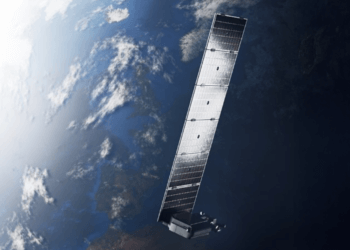
• Upgraded Technology: Featuring advanced beamforming, switching, and custom-designed modems. Each satellite features a flat-panel design to minimize volume. Each satellite contains 3 Optical Intersatellite Link (ISL) lasers.
• Faster Deployment: Optimized for Starship, enabling rapid and cost-effective deployment on a global scale.
Expanding Service and Applications
As of late 2024, Starlink boasted a median global download speeds of 104 Mbps. Regional performance varies, with Botswana leading at 255 Mbps. Starlink also expanded its Direct-to-Cell technology, enabling LTE-compatible messaging and emergency alerts in remote regions. Future upgrades will add voice and IoT connectivity by mid-2025.
Beyond terrestrial services, Starlink expanded in aviation and maritime markets. Agreements with airlines like United and Qatar Airways and partnerships with shipping companies brought reliable connectivity to skies and seas. Additionally, Starlink serves over 75,000 vessels and continues to equip cruise ships and rail systems with high-speed internet.