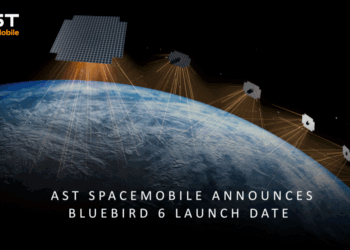
AST SpaceMobile has chosen Blue Origin’s New Glenn rocket to launch its next-generation BlueBird satellites from Cape Canaveral. Scheduled across 2025 and 2026, these launches will deploy approximately 60 Block 2 BlueBird satellites to low Earth orbit, aiming to provide continuous space-based cellular broadband service. AST SpaceMobile’s planned coverage will span high-demand markets, including the U.S., Europe, Japan, and government sectors, supporting a wide array of commercial and government applications.
The upgraded Block 2 BlueBird satellites will offer up to 10 times the bandwidth of current satellites, with communication arrays of up to 2,400 square feet (223 square meters)—the largest to be deployed in low Earth orbit. AST SpaceMobile’s design targets 100% U.S. nationwide coverage, comprising over 5,600 cells delivering peak data speeds of up to 120 Mbps. Equipped to handle 40 MHz capacity beams, the satellites aim to enable seamless voice, data, and video services for mobile users worldwide. This mission aligns with AST SpaceMobile’s goal of filling connectivity gaps for mobile users by leveraging its extensive global partnerships and in-house production.
AST SpaceMobile has secured additional funding from major tech and telecom companies, including AT&T, Verizon, Google, and Vodafone, to support its expansion. With agreements in place with over 45 mobile network operators representing more than 2.8 billion subscribers worldwide, AST SpaceMobile is well-positioned to reach new heights in satellite-based mobile connectivity.
• Launch vehicle: Blue Origin’s New Glenn
• Launch location: Cape Canaveral, Florida
• Targeted coverage: U.S., Europe, Japan, U.S. Government, and global markets
• Block 2 BlueBird capacity: Up to 120 Mbps peak speed, 40 MHz bandwidth per cell
• Communications array size: Up to 2,400 square feet (223 square meters)
• Partnerships: 45 mobile network operators, over 2.8 billion subscribers
• Key investors: AT&T, Verizon, Google, Vodafone, Rakuten, American Tower
“We have now contractually secured orbital launch capacity during 2025 and 2026 to enable continuous cellular broadband service coverage of the AST SpaceMobile network,” said Scott Wisniewski, President of AST SpaceMobile.