• Home
  • Events Calendar
  • Blueprint Guidelines
  • Privacy Policy
  • Subscribe to Daily Newsletter
  • NextGenInfra.io
No Result
View All Result
Converge Digest
Saturday, April 18, 2026
  • Home
  • Events Calendar
  • Blueprint Guidelines
  • Privacy Policy
  • Subscribe to Daily Newsletter
  • NextGenInfra.io
No Result
View All Result
Converge Digest
No Result
View All Result

Home » Vodafone and AMD Collaborate on Advanced 5G Base Station Chips

Vodafone and AMD Collaborate on Advanced 5G Base Station Chips

November 14, 2024
in All
A A

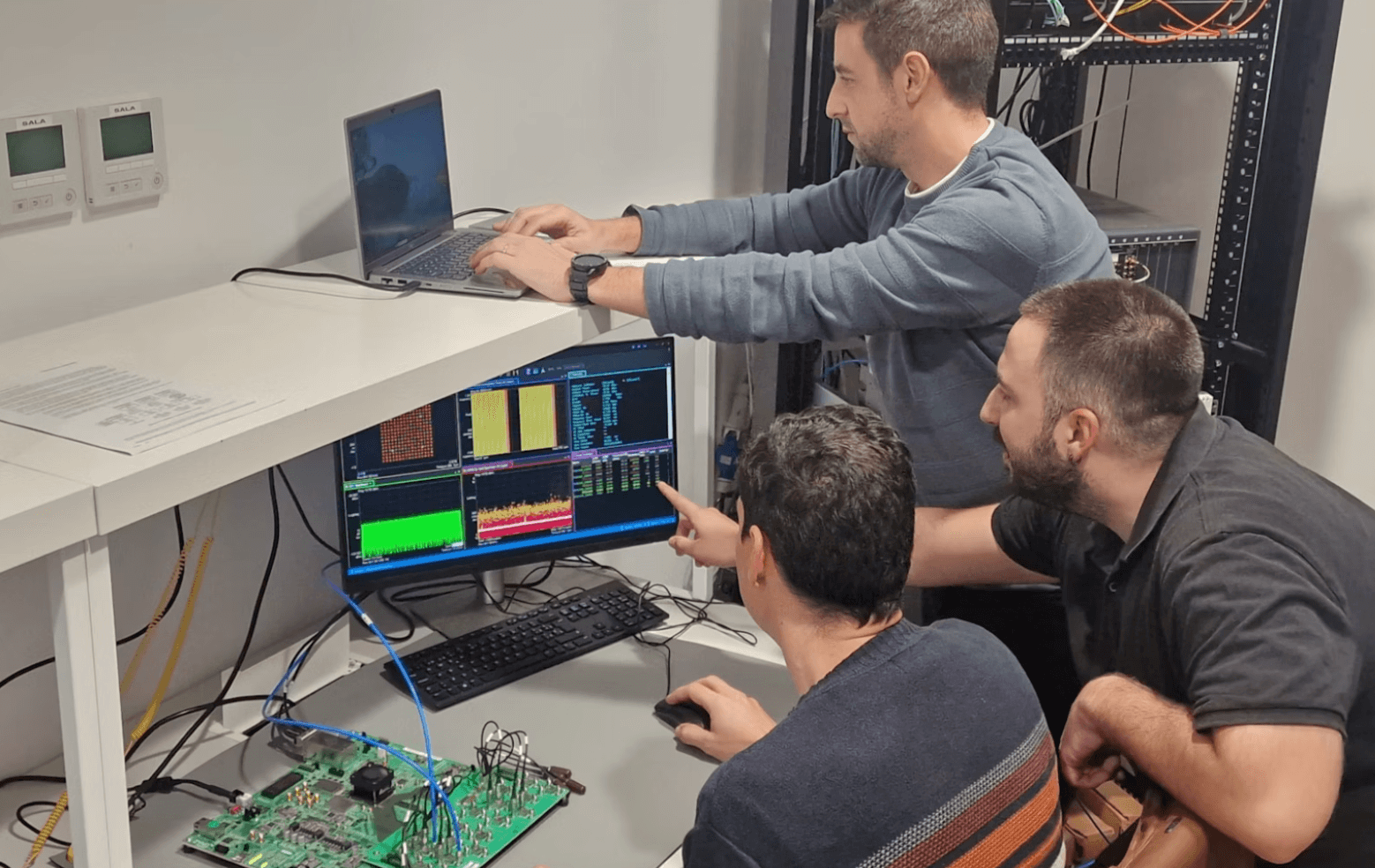
Vodafone has partnered with AMD to design high-performance silicon chips for 5G base stations, aiming to meet growing demands for AI-driven and digital services. The collaboration focuses on developing adaptive radio hardware that boosts capacity, reduces energy consumption, and shrinks the size of radio antennae, all while maintaining coverage quality. Engineers from both companies are testing AMD’s Zynq™ UltraScale+™ RFSoC devices at Vodafone’s Innovation Centre in Málaga, Spain. These single-chip platforms integrate multiple radio functions, including flexible Arm® processors, making them suitable for dynamic 5G deployments.

AMD’s Zynq UltraScale+ RFSoC chips offer a major advantage with their adaptability. Unlike fixed-function Application Specific Integrated Circuits (ASICs), these chips can be remotely reconfigured after deployment, enabling Vodafone to support evolving AI algorithms, new 5G standards, and increased traffic during peak periods without hardware replacements. Their modular architecture also aligns with Open Radio Access Network (Open RAN) principles, allowing seamless integration with equipment from different vendors. Vodafone is simultaneously evaluating compatible radio units from multiple suppliers, fostering a diverse and efficient chip ecosystem.

Energy efficiency is another key focus of this partnership. Vodafone is testing AMD chipsets to optimize power amplifier (PA) efficiency, which accounts for most network energy consumption. Proprietary 5G algorithms dynamically adjust power use based on customer demand, similar to a thermostat, further enhancing efficiency. By embedding these energy-saving technologies, Vodafone can meet future demands for features like network slicing, which provides dedicated, secure network slices to businesses, hospitals, and other critical users.

• Vodafone and AMD developing 5G base station silicon chips.

• Testing conducted at Vodafone’s Innovation Centre in Málaga, Spain.

• AMD Zynq UltraScale+ RFSoC chips enable remote updates and support Open RAN.

• Focus on reducing antenna size, energy consumption, and network power use.

• Algorithms and advanced technologies drive scalability and energy efficiency.

ShareTweetShare
Previous Post

Molex to Acquire AirBorn for Rugged Connectors

Next Post

AST SpaceMobile Signs Blue Origin’s New Glenn Rocket

Jim Carroll

Jim Carroll

Editor and Publisher, Converge! Network Digest, Optical Networks Daily - Covering the full stack of network convergence from Silicon Valley

Related Posts

Cisco, G42, and AMD to Build AI Infrastructure in the UAE
AI Infrastructure

DigitalBridge Teams with KT for AI Data Centers in Korea

November 26, 2025
BerryComm Expands Central Indiana Fiber with Nokia
5G / 6G / Wi-Fi

Telefónica Germany Awards Nokia a 5-Year RAN Modernization Deal

November 26, 2025
AMD’s Compute + Pensando Network Architecture Powers Zyphra’s AI 
AI Infrastructure

AMD’s Compute + Pensando Network Architecture Powers Zyphra’s AI 

November 25, 2025
Bleu, the “Cloud de Confiance” from Capgemini and Orange
Clouds and Carriers

Orange Business Begins Migration of 70% of IT Infrastructure to Bleu Cloud

November 25, 2025
Dell’s server and networking sales rise 16% yoy
Financials

Dell Raises FY26 AI Infrastructure Outlook as AI Server Shipments Surge 150%

November 25, 2025
GlobalFoundries acquires Tagore Technology’s GaN IP
Optical

GlobalFoundries Acquires InfiniLink for Silicon-Photonics Expertise

November 25, 2025
Next Post
AST SpaceMobile Signs Blue Origin’s New Glenn Rocket

AST SpaceMobile Signs Blue Origin’s New Glenn Rocket

Categories

  • 5G / 6G / Wi-Fi
  • AI Infrastructure
  • All
  • Automotive Networking
  • Blueprints
  • Clouds and Carriers
  • Data Centers
  • Enterprise
  • Explainer
  • Feature
  • Financials
  • Last Mile / Middle Mile
  • Legal / Regulatory
  • Optical
  • Quantum
  • Research
  • Security
  • Semiconductors
  • Space
  • Start-ups
  • Subsea
  • Sustainability
  • Video
  • Webinars

Archives

Tags

5G All AT&T Australia AWS Blueprint columns BroadbandWireless Broadcom China Ciena Cisco Data Centers Dell'Oro Ericsson FCC Financial Financials Huawei Infinera Intel Japan Juniper Last Mile Last Mille LTE Mergers and Acquisitions Mobile NFV Nokia Optical Packet Systems PacketVoice People Regulatory Satellite SDN Service Providers Silicon Silicon Valley StandardsWatch Storage TTP UK Verizon Wi-Fi
Converge Digest

A private dossier for networking and telecoms

Follow Us

  • Home
  • Events Calendar
  • Blueprint Guidelines
  • Privacy Policy
  • Subscribe to Daily Newsletter
  • NextGenInfra.io

© 2025 Converge Digest - A private dossier for networking and telecoms.

No Result
View All Result
  • Home
  • Events Calendar
  • Blueprint Guidelines
  • Privacy Policy
  • Subscribe to Daily Newsletter
  • NextGenInfra.io

© 2025 Converge Digest - A private dossier for networking and telecoms.

This website uses cookies. By continuing to use this website you are giving consent to cookies being used. Visit our Privacy and Cookie Policy.
Go to mobile version