• Home
  • Events Calendar
  • Blueprint Guidelines
  • Privacy Policy
  • Subscribe to Daily Newsletter
  • NextGenInfra.io
No Result
View All Result
Converge Digest
Friday, April 10, 2026
  • Home
  • Events Calendar
  • Blueprint Guidelines
  • Privacy Policy
  • Subscribe to Daily Newsletter
  • NextGenInfra.io
No Result
View All Result
Converge Digest
No Result
View All Result

Home » Starship’s PEZ Dispenser Unlocks Starlink’s Multi-Tbps Future

Starship’s PEZ Dispenser Unlocks Starlink’s Multi-Tbps Future

August 27, 2025
in Space
A A

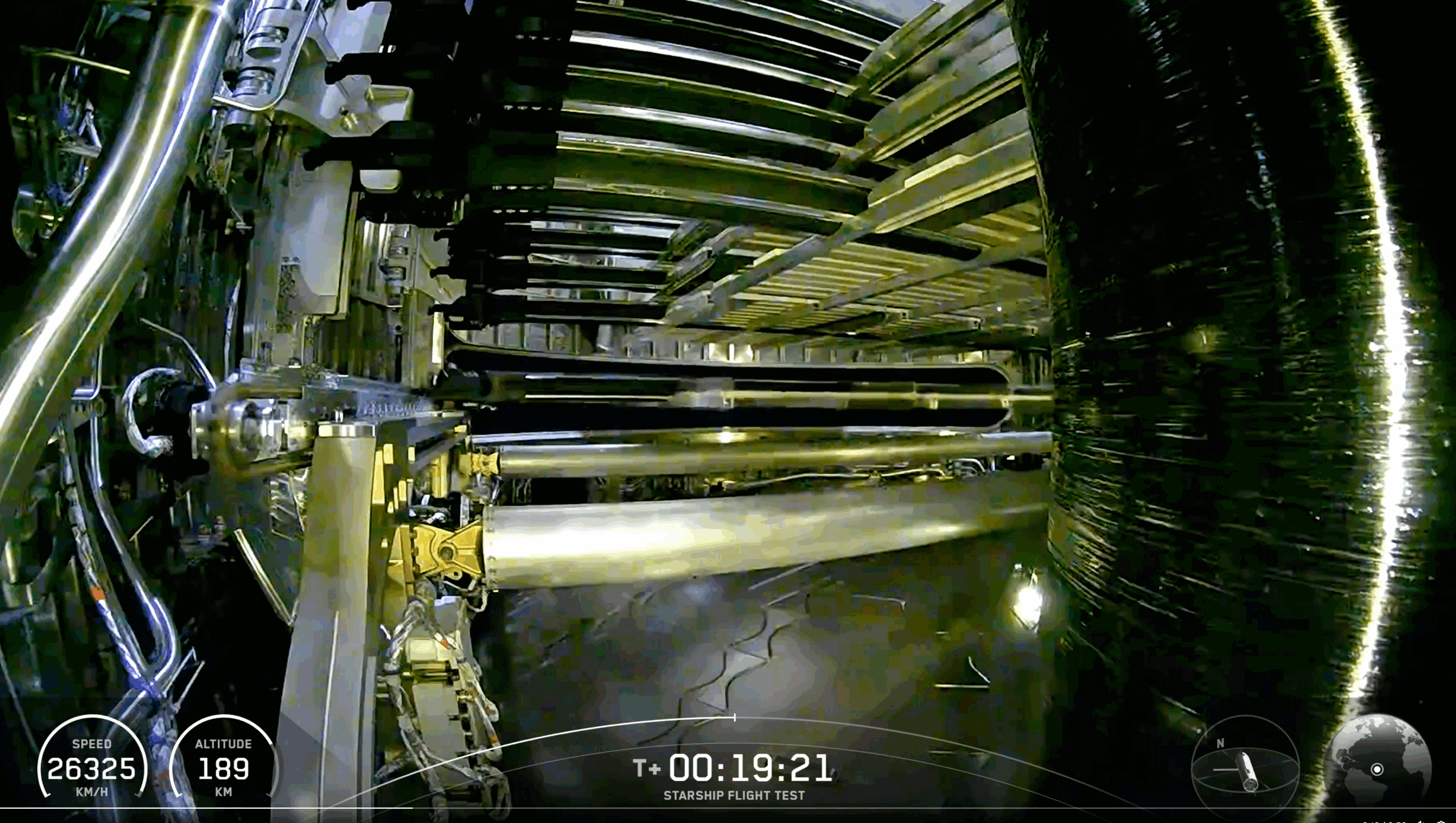
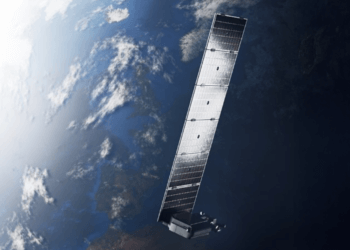
SpaceX moved closer to a radical expansion of Starlink’s global network on August 26, when Starship’s tenth test flight successfully demonstrated a “PEZ” satellite deployment system. The upper stage released eight mock Starlink satellites on a suborbital trajectory, validating a payload door and dispenser designed to deploy dozens of spacecraft in rapid sequence. This capability sets the stage for Starlink’s largest leap in capacity since the project’s launch.

The upcoming Starlink V3 satellites weigh roughly 1,900 kg each, about 3.3 times heavier than the V2 Mini models currently launched on Falcon 9, which weigh approximately 575 kg. Each V3 unit is designed to deliver about 1 Tbps of downlink and up to 4 Tbps of combined RF and optical inter-satellite capacity. With Starship capable of carrying up to 60 V3 satellites in a single mission, a single launch could add 60 Tbps of throughput to the constellation. By comparison, a Falcon 9 launch of ~20–22 V2 Minis adds roughly 2 Tbps. The shift represents an order-of-magnitude increase in Starlink’s ability to scale.

SpaceX envisions Starship becoming the workhorse of Starlink’s continued buildout, potentially deploying hundreds of V3 satellites per month once flight cadence stabilizes. The PEZ-style dispenser—so named because satellites are pushed out sequentially like candy—enables Starship to empty its payload bay rapidly, reducing deployment complexity. If Starship achieves full reusability and a high flight cadence, this system could allow SpaceX to bring thousands of terabits of new bandwidth online annually, setting Starlink apart from any rival constellation in terms of both scale and economics.

  • Starship test flight 10 validated PEZ dispenser with eight mock Starlink satellites on a suborbital trajectory
  • Starlink V3 satellites: ~1,900 kg each, ~3.3 times heavier than V2 Mini models (575 kg), 1 Tbps downlink, 4 Tbps total capacity
  • Starship capacity: Up to 60 V3 satellites per launch (~60 Tbps of new throughput per flight)
  • Capacity comparison: Falcon 9 launches add ~2 Tbps; Starship adds 30× more per flight
  • Strategic impact: Enables exponential growth of Starlink constellation capacity and coverage

🌐 Analysis:  Starship’s PEZ system transforms Starlink’s scaling model from incremental to exponential. By combining heavier V3 satellites with mass deployment capability, SpaceX positions Starlink as the first truly global, multi-Tbps LEO network. The strategy mirrors hyperscaler buildouts in data centers—capacity ramps rapidly once platform bottlenecks are solved. Competitors like Amazon’s Project Kuiper, planning 3,236 satellites, and OneWeb, targeting enterprise markets, will face pressure to match not just coverage but raw throughput, a challenge without a comparable heavy-lift, reusable launch system.

https://www.spacex.com/launches/starship-flight-10

Tags: SpaceXStarlink
ShareTweetShare
Previous Post

CrowdStrike Q2 FY26 Revenue Jumps 21%, ARR Hits $4.66B

Next Post

Mplify Launches LSO API Certification to Drive Global NaaS 

Jim Carroll

Jim Carroll

Editor and Publisher, Converge! Network Digest, Optical Networks Daily - Covering the full stack of network convergence from Silicon Valley

Related Posts

MetTel Extends SD-WAN Services Globally as Starlink Reseller
Space

Vodacom Taps Starlink Across Africa

November 14, 2025
SpaceX launches 48 more Starlink satellites
Space

EchoStar to Sell $17 Billion Spectrum Portfolio to SpaceX fo

November 6, 2025
MetTel Extends SD-WAN Services Globally as Starlink Reseller
Space

BT Signs with Starlink to Deliver Satellite Broadband Across the UK

November 6, 2025
Muon Space to Integrate SpaceX’s Starlink Mini Space Lasers
Space

Muon Space to Integrate SpaceX’s Starlink Mini Space Lasers

October 21, 2025
MetTel Extends SD-WAN Services Globally as Starlink Reseller
5G / 6G / Wi-Fi

SpaceX Gains 50 MHz S-band, Paving Way for Satellite-Grade 5G

September 8, 2025
SpaceX Launches SES’s 9th and 10th O3b mPOWER Satellites
Space

SpaceX Launches SES’s 9th and 10th O3b mPOWER Satellites

July 22, 2025
Next Post
MEF Rebrands as Mplify — What’s Next for AI-Driven, Automated Network Services

Mplify Launches LSO API Certification to Drive Global NaaS 

Categories

  • 5G / 6G / Wi-Fi
  • AI Infrastructure
  • All
  • Automotive Networking
  • Blueprints
  • Clouds and Carriers
  • Data Centers
  • Enterprise
  • Explainer
  • Feature
  • Financials
  • Last Mile / Middle Mile
  • Legal / Regulatory
  • Optical
  • Quantum
  • Research
  • Security
  • Semiconductors
  • Space
  • Start-ups
  • Subsea
  • Sustainability
  • Video
  • Webinars

Archives

Tags

5G All AT&T Australia AWS Blueprint columns BroadbandWireless Broadcom China Ciena Cisco Data Centers Dell'Oro Ericsson FCC Financial Financials Huawei Infinera Intel Japan Juniper Last Mile Last Mille LTE Mergers and Acquisitions Mobile NFV Nokia Optical Packet Systems PacketVoice People Regulatory Satellite SDN Service Providers Silicon Silicon Valley StandardsWatch Storage TTP UK Verizon Wi-Fi
Converge Digest

A private dossier for networking and telecoms

Follow Us

  • Home
  • Events Calendar
  • Blueprint Guidelines
  • Privacy Policy
  • Subscribe to Daily Newsletter
  • NextGenInfra.io

© 2025 Converge Digest - A private dossier for networking and telecoms.

No Result
View All Result
  • Home
  • Events Calendar
  • Blueprint Guidelines
  • Privacy Policy
  • Subscribe to Daily Newsletter
  • NextGenInfra.io

© 2025 Converge Digest - A private dossier for networking and telecoms.

This website uses cookies. By continuing to use this website you are giving consent to cookies being used. Visit our Privacy and Cookie Policy.
Go to mobile version